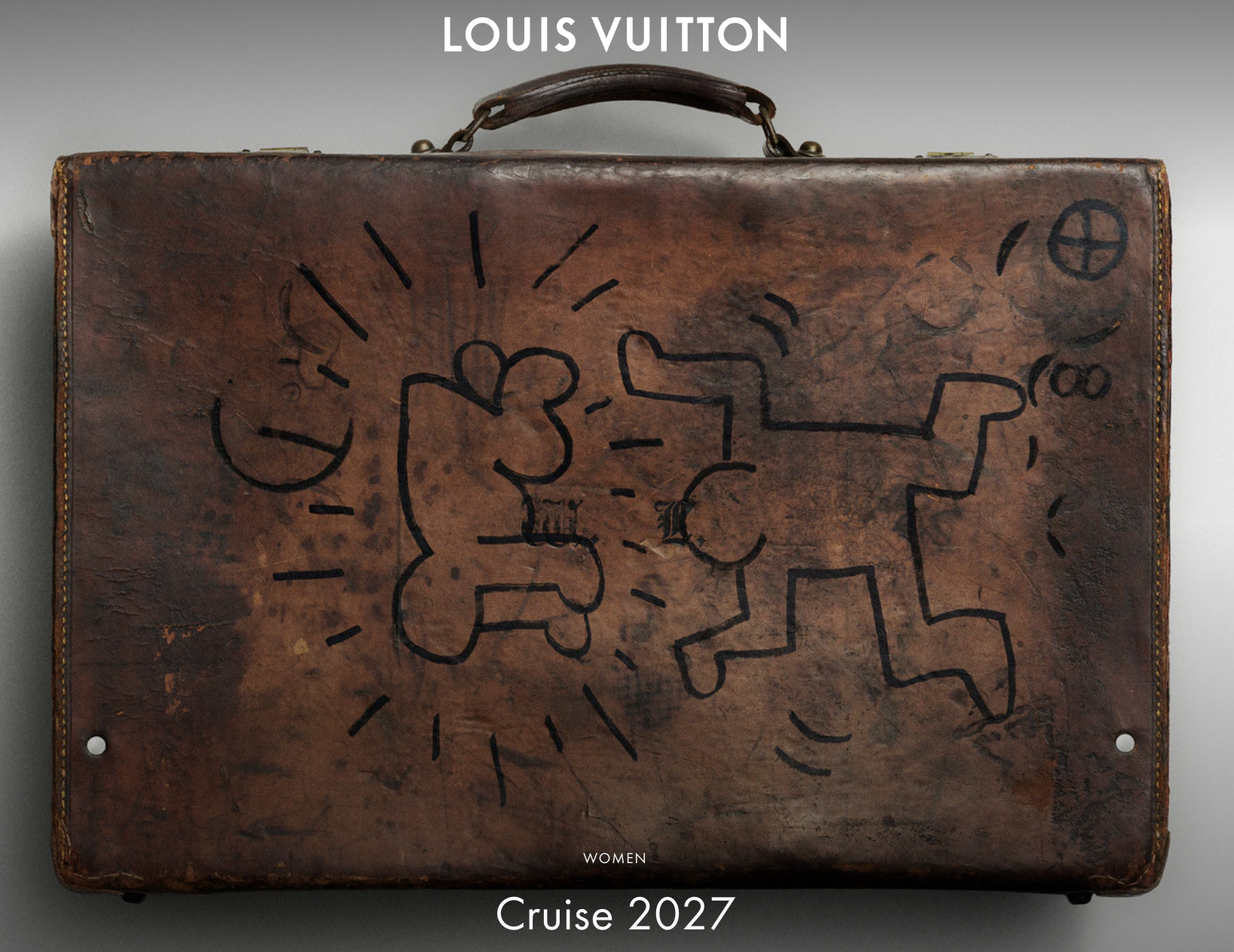
At Louis in the Wild, our lens has always favored objects with lineage—pieces shaped by history rather than novelty. Few luxury houses reward that perspective as consistently as Louis Vuitton.
Louis Vuitton is not sustained by trend cycles. It is sustained by objects that solved real problems so effectively that they transcended their original purpose. Long before the house became shorthand for status, it was known for engineering solutions to movement: travel trunks that stacked, canvases that resisted moisture, closures that endured decades of handling.
The handbags that define Louis Vuitton today are not fashion inventions in the modern sense. They are evolutions—descendants of travel instruments refined through material science, proportion, and cultural adoption. To collect Louis Vuitton seriously is to understand where those objects began, how they were produced, and why they continue to matter.
The Speedy
The Handbag That Shrunk the Trunk—and Changed Everything


The Louis Vuitton Speedy is often introduced as a casual, everyday bag. That framing dramatically understates its importance.
The Speedy traces its origins to the early 1930s, when Louis Vuitton introduced a soft-sided travel bag known as the Express. This was a direct response to changes in transportation infrastructure. Rail travel was accelerating, and travelers no longer needed rigid trunks for short journeys. What they needed was portability without fragility.
The Express—later renamed the Speedy—was constructed using the same coated canvas that had already proven itself on ocean liners and railway platforms. Its defining features were not decorative: a reinforced base to distribute weight, rolled leather handles to withstand repeated stress, and a zip closure at a time when open-top bags were still common.
The Speedy’s transformation into a cultural icon occurred decades later, when Audrey Hepburn requested a smaller version suitable for daily use. The resulting Speedy 25 did more than adjust proportions—it reframed the bag entirely. What had been a travel companion became an urban essential.
From a collector’s standpoint, the Speedy offers a rare combination of accessibility and historical purity. Its design has remained materially consistent across generations, making early examples particularly instructive. Pre-1990s Speedys, often identified by thicker canvas, heavier brass hardware, and more substantial vachetta leather, are increasingly favored for their tactile quality and aging characteristics.
Importantly, the Speedy also established a blueprint: a utilitarian object elevated through proportion and repetition rather than ornamentation. That philosophy would echo through nearly every successful Vuitton bag that followed.
The Keepall
The Soft Luggage That Redefined Luxury Travel

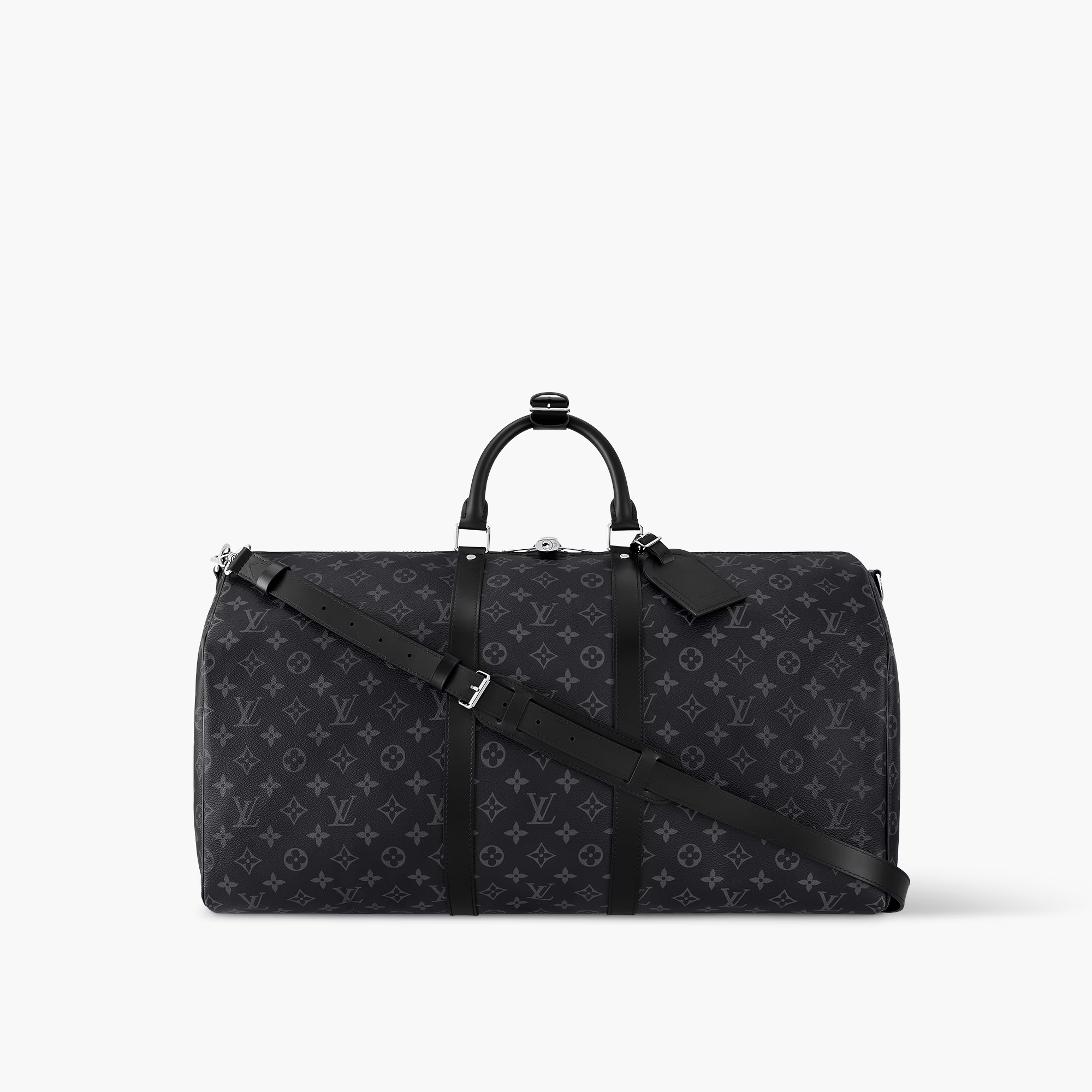
Introduced in 1930, the Louis Vuitton Keepall represents one of the most consequential design shifts in Louis Vuitton’s history.
Until the Keepall, luxury travel luggage was rigid by default. Trunks were expected to hold shape at all costs. The Keepall challenged that assumption by embracing flexibility—without sacrificing strength. Constructed from coated canvas with reinforced seams and leather trim, it was designed to be folded flat, stowed easily, and carried comfortably.
This was not a stylistic experiment; it was a logistical breakthrough.
For collectors, the Keepall is significant for several reasons. It marks the moment when Louis Vuitton fully committed to soft luxury, and it has remained remarkably consistent in silhouette across nearly a century of production. While materials and finishes have evolved, the underlying form remains intact.
The Keepall’s cultural migration—from functional luggage to symbol of cosmopolitan mobility—accelerated in the late 20th century. Under the creative direction of Marc Jacobs, the Keepall became a canvas for collaboration and reinterpretation. Under Virgil Abloh, it became a statement of identity and authorship.
Yet despite these evolutions, the classic Monogram Keepall remains the most enduring—and, for collectors, the most instructive. Vintage examples demonstrate how the bag was intended to age: softened canvas, darkened leather, and a patina that records movement rather than hiding it.
The Alma
Geometry, Structure, and the Discipline of Shape


Where many Louis Vuitton bags derive their authority from flexibility, the Louis Vuitton Alma asserts itself through structure.
Developed in the 1930s and influenced by Art Deco design language, the Alma was conceived as a handbag that would retain its form indefinitely. Its domed silhouette, reinforced base, and rigid frame distinguish it from the softer travel-derived models that dominate the Vuitton catalog.
The Alma’s construction demands precision. Any deviation in symmetry or reinforcement becomes immediately visible. This makes it both a technical achievement and a revealing object for collectors: poorly preserved examples show wear quickly, while well-maintained vintage Almas appear almost timeless.
The introduction of Epi leather in the 1980s further elevated the Alma’s collector appeal. Unlike Monogram canvas, Epi offered color saturation, texture, and resistance to environmental wear. Discontinued Epi colors—particularly those produced in limited runs—are now increasingly difficult to source in excellent condition.
From a historical perspective, the Alma represents Louis Vuitton’s ability to translate its travel DNA into a more formal, architectural language without losing durability or identity.
The Noé
When Utility Becomes Iconography
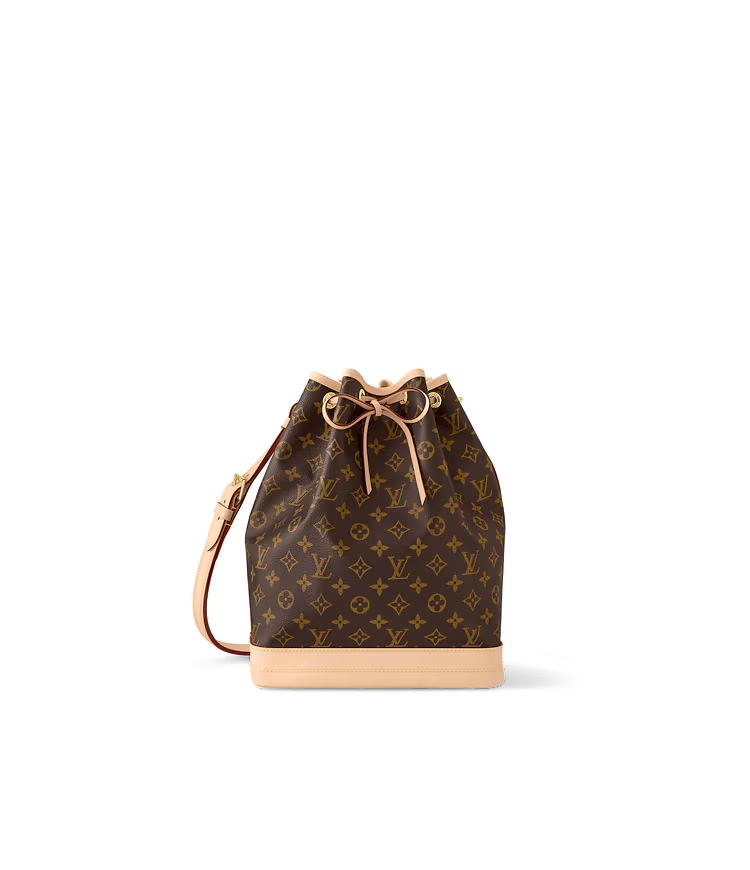


The Louis Vuitton Noé is one of the most honest bags Louis Vuitton has ever produced.
Designed in 1932 at the request of a champagne producer, the Noé was built to carry five bottles upright and one inverted. Its bucket shape, reinforced base, and drawstring closure were dictated entirely by function. There was no initial concern for fashion longevity—only performance.
That clarity of purpose is precisely what has allowed the Noé to endure.
Collectors value the Noé for its construction logic. The drawstring closure distributes tension evenly, reducing strain on the canvas. The wide base prevents sagging. Earlier versions, produced when canvas weights were heavier, offer a tactile experience that many modern collectors actively seek.
The Noé’s transition into a fashion staple occurred organically, driven by adoption rather than marketing. Its continued relevance underscores a core Vuitton principle: designs that solve real problems rarely age out.
The Neverfull
Modernity Through Reduction


The Louis Vuitton Neverfull, introduced in 2007, is often dismissed as contemporary or ubiquitous. That view overlooks its structural intelligence.
The Neverfull was designed during a period when daily carry needs were expanding—laptops, documents, travel essentials—yet consumers demanded lightness. The bag’s genius lies in its restraint: minimal hardware, thin yet durable canvas, reinforced side laces that allow shape adjustment without compromising integrity.
From a collector’s standpoint, the Neverfull is still in its early phase of historical evaluation. However, early production examples—particularly those with original interior linings and pre-adjustment canvas weights—are already being differentiated in the secondary market.
The Neverfull’s long-term significance will likely mirror that of the Speedy: a bag initially viewed as utilitarian, later recognized as foundational.
Creative Direction and Continuity
Evolution Without Erosion
Louis Vuitton’s longevity rests on a disciplined refusal to dismantle its core designs.


Some of Louis Vuitton’s former creative directors, from Marc Jacobs (1997–2013) to Virgil Abloh (2018–2021), expanded the house’s visual language without rewriting its grammar. Classic silhouettes remained intact while materials, colors, and contexts evolved around them—proof that Vuitton’s most valuable “codes” aren’t seasonal ideas, but durable design architecture.
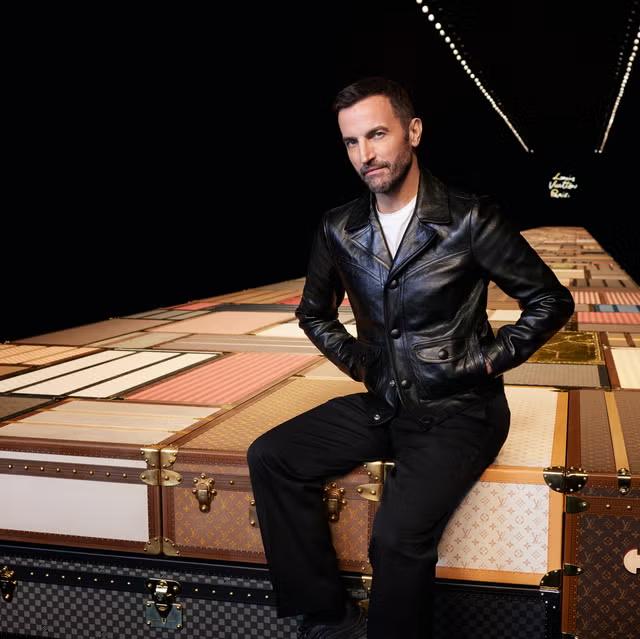

Even today, that continuity is deliberate: on the women’s side, Nicolas Ghesquière (Artistic Director of Women’s Collections since 2013) continues to modernize the house’s handbag vocabulary through sharp structure, futuristic hardware, and new icons that still speak fluent Vuitton; on the men’s side, Pharrell Williams (Men’s Creative Director) brings fresh cultural energy and material play to heritage forms without severing the link to the “trunk-and-travel” DNA. And beyond leather goods, Vuitton’s broader product universe continues to be shaped through evolving leadership—most notably in jewelry and watches, where the brand has undergone a recent creative transition following the departure of Francesca Amfitheatrof in 2025, underscoring that Vuitton’s evolution is ongoing, carefully stewarded, and increasingly multi-category.
For collectors, this continuity is critical. It ensures that objects remain legible across decades, preserving both cultural recognition and market stability.
Collecting Louis Vuitton with Intention
Serious Louis Vuitton collecting is less about acquisition and more about discernment.
Condition, provenance, material integrity, and production era all matter. So does restraint. The most successful collections prioritize objects that embody the house’s original problem-solving ethos, not seasonal embellishments.
These bags were built to move. To age. To accumulate history.
That is why they remain.
Closing Thought
Louis Vuitton’s greatest achievement is not branding—it is endurance.
These bags have survived wars, technological revolutions, and shifting definitions of luxury because they were never designed to chase relevance. They were designed to earn it.
And they still do.
Sources & References
- Louis Vuitton Official Heritage & Archives
- Louis Vuitton: The Birth of Modern Luxury — Paul-Gérard Pasols
- Victoria and Albert Museum fashion and luggage collections
- The Metropolitan Museum of Art Costume Institute archives
- Sotheby’s & Christie’s luxury handbag auction catalogs
- Vogue archival runway and accessory coverage
- Harper’s Bazaar historical fashion features