When Pharrell Williams was appointed Men’s Creative Director at Louis Vuitton in 2023, the announcement resonated far beyond the fashion industry. It was not simply the hiring of a celebrated creative—it was a declaration of intent. Louis Vuitton was signaling that its future would be shaped not just by design excellence, but by culture, storytelling, and global dialogue.
“I see myself as a student of life,” Williams has said. “Everything I do creatively is about curiosity—about learning, absorbing, and translating what the world feels like right now.” That philosophy sits at the heart of his work for Louis Vuitton, and it comes fully into focus in the Making of Men’s Spring-Summer 2026 video, which documents the thinking, collaboration, and intent behind the collection.
Rather than positioning the video as the primary narrative, it functions best as a companion—an intimate window into a larger story about where Williams is guiding Louis Vuitton menswear, and what modern luxury can represent in the 21st century.
From Cultural Contributor to Cultural Architect

Pharrell’s relationship with Louis Vuitton did not begin with his appointment. Long before he held a formal title, he collaborated with the house on accessories, jewelry, and creative projects dating back to the Marc Jacobs era. These early partnerships hinted at a shared worldview: luxury as an evolving cultural language rather than a static set of rules.
When CEO Pietro Beccari described Williams’s appointment as a “homecoming,” it underscored something deeper than nostalgia. It reflected Vuitton’s belief that Williams understands the brand’s heritage while being uniquely equipped to translate it for a new generation.
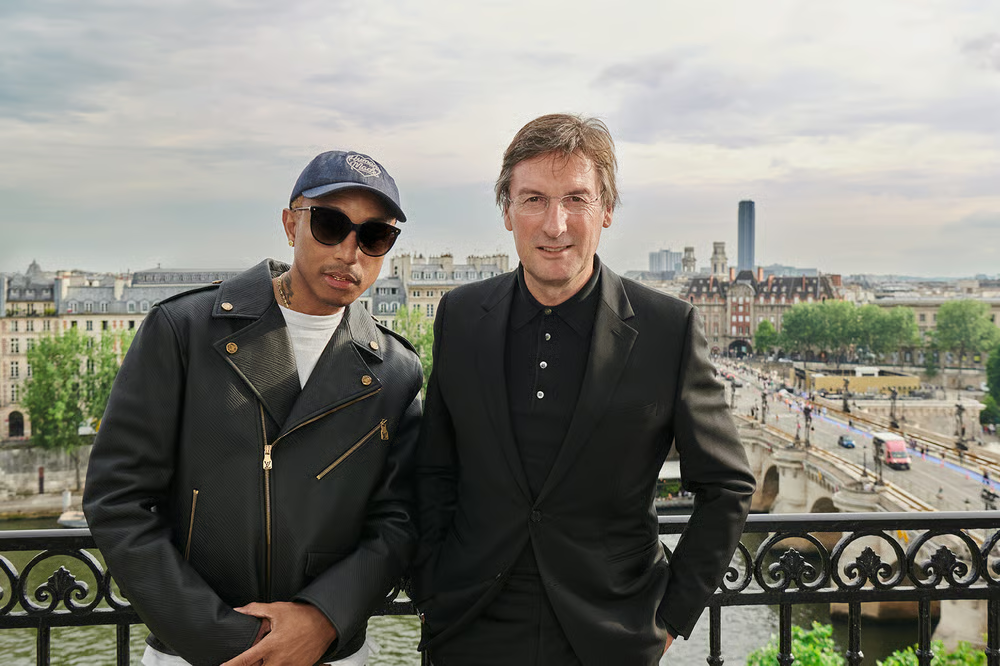
Pharrell himself framed the role in expansive terms. “This isn’t about me designing clothes in isolation,” he has explained. “It’s about building ideas—ideas that connect people, cultures, and perspectives.” That mindset positions him less as a traditional fashion designer and more as a cultural architect, shaping how Louis Vuitton participates in the broader creative conversation.
Spring-Summer 2026: Process, Philosophy, and Meaning
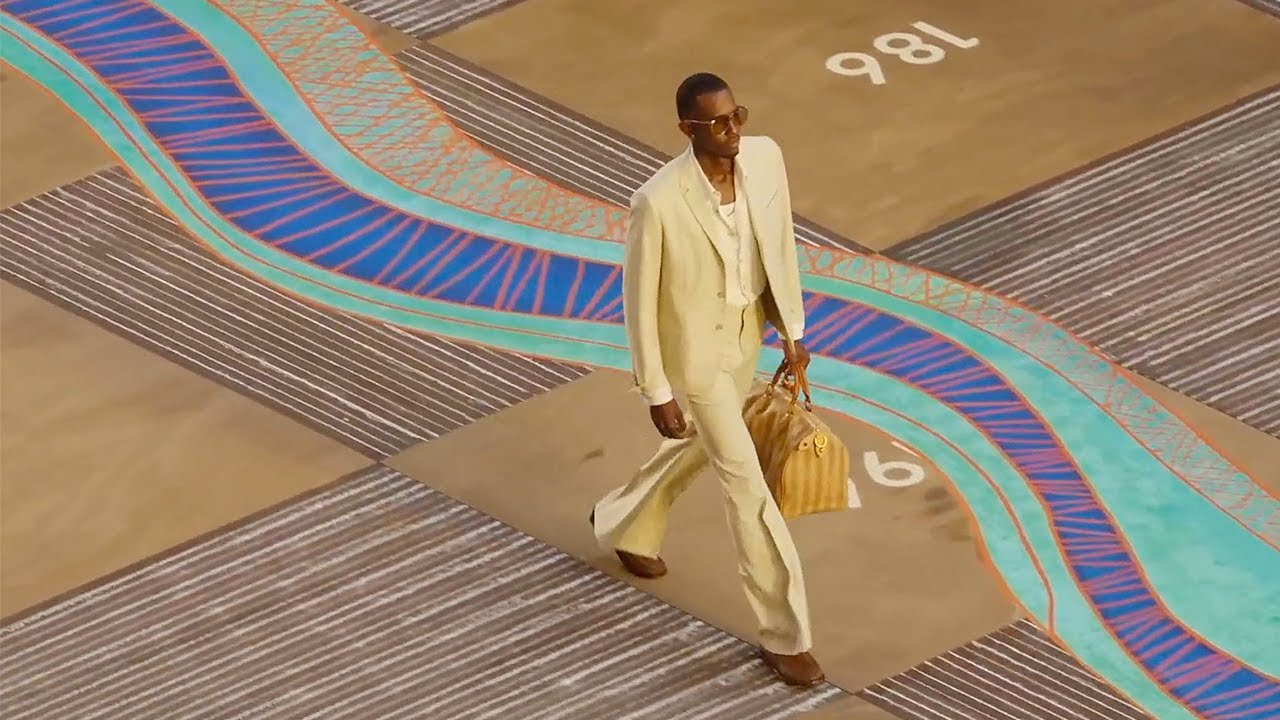
The Making of Men’s Spring-Summer 2026 video reveals a creative process rooted in collaboration and symbolism. Working alongside architect Bijoy Jain, Williams helped transform the runway environment into a conceptual landscape inspired by Snakes and Ladders—a metaphor for life’s unpredictable ascents and descents.
“Life isn’t linear,” Pharrell notes in the film. “You climb, you fall, you learn—and you move forward with more awareness.” That idea informs not only the staging of the show but the collection itself, which balances structure with fluidity, tradition with experimentation.
The garments echo this philosophy. Architectural silhouettes coexist with playful proportions. Precision tailoring is offset by moments of softness and movement. Nothing feels accidental, yet nothing feels rigid. It is luxury presented not as perfection, but as progress.
Jain’s involvement reinforces this narrative depth. His architectural sensibility brings a contemplative stillness to the presentation—inviting viewers to slow down and absorb the meaning behind the work. The result is fashion that communicates ideas, not just aesthetics.
Redefining Luxury Through Culture and Inclusion

Central to Pharrell Williams’s vision for Louis Vuitton is the belief that creativity should be expansive, inclusive, and culturally fluent. He has repeatedly emphasized that luxury should reflect the world as it is—not as it once was.
“Luxury is about intention,” Williams has said. “It’s about care, respect, and meaning—not about exclusion.” This ethos permeates his collections, which draw inspiration from multiple cultures, disciplines, and lived experiences.
Rather than relying on nostalgia alone, Pharrell recontextualizes Louis Vuitton’s heritage for a global audience shaped by music, street culture, digital media, and cross-cultural exchange. His work speaks to collectors and newcomers alike, bridging the gap between legacy luxury and contemporary relevance.
This approach aligns seamlessly with Vuitton’s historical identity as a house rooted in travel, movement, and exploration. Under Pharrell’s direction, those themes evolve into metaphors for personal growth, creative freedom, and cultural exchange.
Fashion as a Multidisciplinary Platform

One of the most distinctive aspects of Pharrell’s leadership is his refusal to separate fashion from other creative forms. Music, art, and storytelling are not accessories to the collections—they are integral to them.
Runway shows under his tenure often debut original music, collaborative performances, or exclusive soundscapes. In Pharrell’s world, fashion does not exist in a vacuum; it lives alongside rhythm, architecture, and visual narrative.
“Everything influences everything,” he has remarked. “That’s how culture works.” By embracing this interconnectedness, Louis Vuitton becomes more than a fashion house—it becomes a platform for cultural expression.
A Broader Vision for Louis Vuitton

Pharrell Williams is not focused solely on seasonal success. His long-term vision positions Louis Vuitton as a cultural beacon—one that honors craftsmanship while engaging meaningfully with the present moment.
This strategy reflects a larger shift within luxury fashion, where relevance is earned through authenticity rather than exclusivity alone. Under Pharrell’s guidance, Louis Vuitton menswear becomes a space for ideas, dialogue, and shared experience.
Spring-Summer 2026 stands as a clear expression of that philosophy. It is not just a collection, but a statement of intent: luxury as storytelling, fashion as culture, and creativity as a collaborative force.
Why This Moment Matters

As Louis Vuitton continues to evolve under Pharrell Williams’s creative direction, the brand’s menswear is increasingly defined by meaning rather than trend. His work invites audiences to engage with fashion not simply as consumers, but as participants in a broader cultural narrative.
In an era where attention is fleeting, Pharrell’s approach offers something enduring: work that rewards curiosity, values diversity, and respects the intelligence of its audience.
The Making of Men’s Spring-Summer 2026 video provides a rare glimpse into that process—but the story itself extends far beyond the screen. It is the story of a house willing to evolve, and a creative director determined to ensure that luxury remains not only beautiful, but culturally alive.