


A Modern Bag with a Long Memory
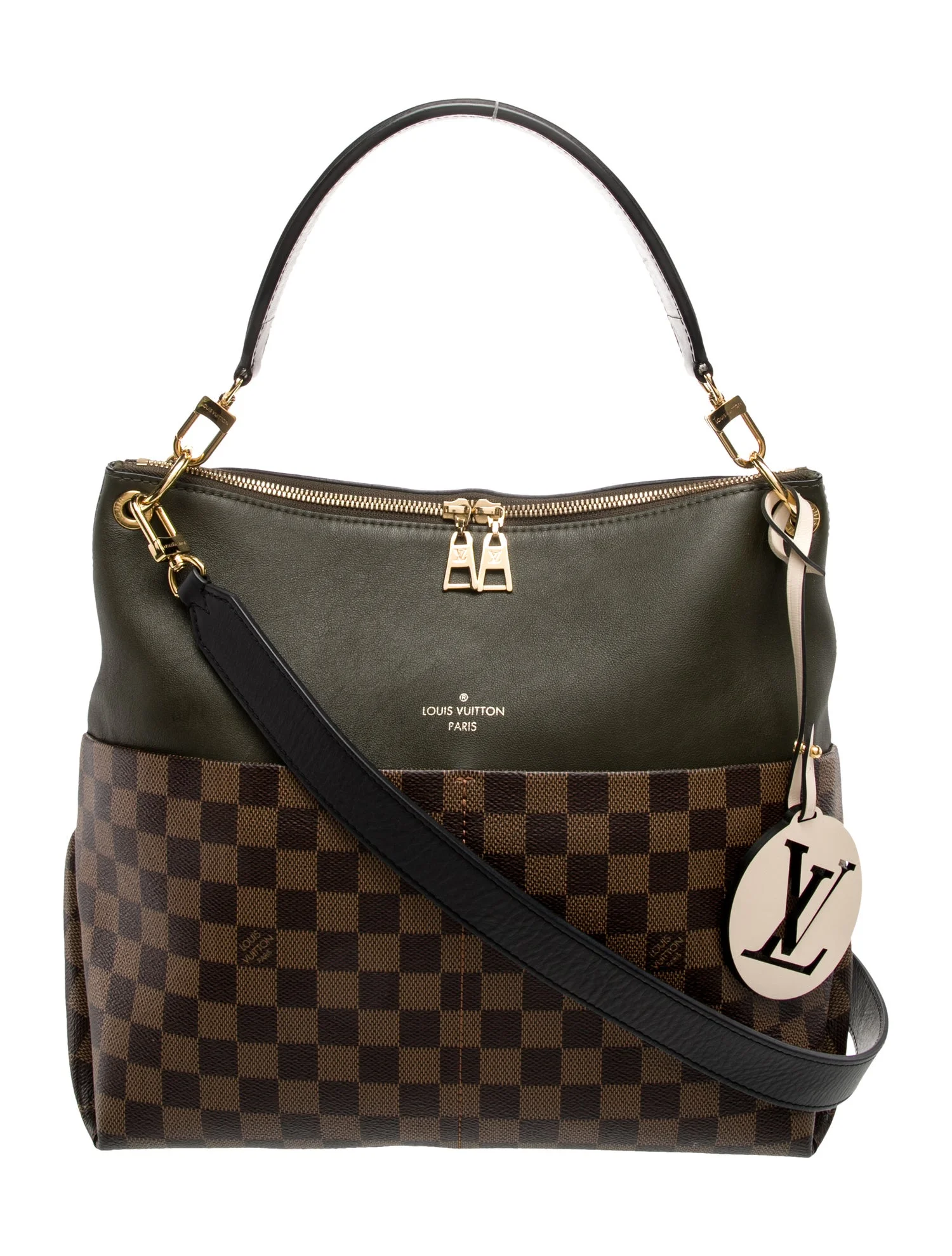
The Louis Vuitton Maida Hobo occupies an unusual but compelling place within the house’s vast catalog. It is neither a century-old icon nor a fleeting novelty, but rather a modern, thoughtfully engineered handbag that draws its authority from one of Louis Vuitton’s oldest visual signatures. In Damier Ebene, the Maida becomes a case study in how heritage patterns continue to be reinterpreted for contemporary life—quietly, confidently, and with purpose.
While the Maida is no longer offered through official Louis Vuitton boutiques, its continued presence in the secondary market tells a different story. This is a bag that resonated with owners not because of hype or celebrity endorsement, but because it solved a problem: how to make a luxury hobo that actually works for everyday life.
Damier Ebene: The Pattern That Anchors the Story

To understand the Maida, one must begin with Damier itself. Introduced in 1888 by Louis Vuitton and his son Georges, the Damier checkerboard predates the Monogram canvas by nearly a decade. It was conceived not only as a decorative motif, but as an early form of brand authentication—a visual language that was difficult to counterfeit and instantly recognizable.


Damier Ebene, (French for “checkerboard brown”) the brown-toned iteration most associated with the Maida, was reintroduced by Louis Vuitton in 1998, restoring the pattern to prominence after years largely absent from the modern lineup. Unlike Monogram, which announces itself loudly, Damier Ebene communicates restraint. Its matte finish, tonal palette, and absence of overt logos make it a favorite among collectors who prefer subtlety over spectacle.
By placing Damier Ebene on the Maida Hobo, Louis Vuitton was not reviving history so much as deploying it—using a time-tested surface to lend gravitas to a thoroughly modern silhouette.
The Maida Concept: Modern Utility, Refined

The Maida Hobo debuted around Fall/Winter 2020, during a period when Louis Vuitton’s women’s collections increasingly emphasized practicality without sacrificing polish. This was the era of adaptable bags—pieces designed to move fluidly between work, travel, and daily life.
At its core, the Maida is a true hobo: softly structured, gently slouching, and designed to sit comfortably against the body. Unlike more rigid shoulder bags, the Maida adapts to its contents and its wearer, developing character over time rather than resisting it.
What distinguishes the Maida from other LV hobos is not just its shape, but its engineering. The bag features a secure top zip closure, a generously sized main compartment, and thoughtfully placed interior pockets that support daily organization without over-complication. Two exterior pockets—an uncommon move for Louis Vuitton—underscore the Maida’s real-world intent, offering quick access to essentials without opening the main body of the bag.
Materials and Construction: Quietly Luxurious

In its Damier Ebene configuration, the Maida Hobo is constructed from coated canvas, trimmed with smooth calfskin leather. This combination is classic Louis Vuitton: durable where it needs to be, supple where it matters. Gold-tone hardware adds warmth and contrast without drifting into flashiness.
Pre-owned examples consistently reflect medium-to-large proportions, with dimensions that strike a balance between capacity and wearability. The Maida comfortably accommodates daily essentials—wallet, phone, cosmetics, tablet—while remaining visually composed. Owners often describe the interior as deceptively spacious, an attribute common to well-designed hobos.

The bag’s convertible carry system reinforces its versatility. A leather handle allows for arm or shoulder carry, while a detachable, adjustable strap enables crossbody wear. This adaptability is central to the Maida’s appeal and reflects a broader shift in luxury design toward flexibility rather than formality.
Creative Context and Design Attribution

Louis Vuitton does not publicly credit individual designers for specific handbag models, and the Maida is no exception. What can be stated with confidence is that the Maida was developed under the creative leadership of Nicolas Ghesquière, Artistic Director of Women’s Collections from November 2013 through March 2024.
Ghesquière’s tenure has been defined by the modernization of house codes—taking familiar motifs and recontextualizing them for contemporary life. The Maida fits comfortably within this philosophy. It is not radical, nor is it archival. Instead, it reflects a mature design language that values usability, signature detail, and restraint.
Any attempt to attribute the Maida to a single designer would be speculative. What is clear is that it emerged from a design studio increasingly attentive to how luxury bags are actually used.
Variations Within the Maida Family


While this essay centers on the Damier Ebene Maida Hobo, the Maida line also appeared in Monogram Empreinte leather, most notably in black. These leather versions leaned further into luxury craftsmanship, often featuring braided leather handles and an all-leather construction that appealed to a different segment of the LV audience.
Across materials, the Maida maintained its defining traits: hobo silhouette, convertible carry, exterior pockets, and an emphasis on everyday functionality. Differences lay primarily in surface treatment and tactile experience rather than fundamental design.
Discontinuation: What We Know—and What We Don’t

The Maida Hobo is no longer part of Louis Vuitton’s active retail assortment. Today, it exists almost exclusively in the pre-owned market. Louis Vuitton has not issued any public statement explaining its discontinuation.
What follows, therefore, must be framed as informed interpretation, not official fact.
Luxury houses routinely retire non-icon silhouettes to streamline collections and make room for new designs. The Maida occupied a competitive internal space—one shared with other hobos and soft shoulder bags offering similar capacity and versatility. As newer models emerged, the Maida likely became redundant within the broader lineup.
Additionally, bags with mixed materials, exterior pockets, and complex construction can be more demanding to produce than simpler silhouettes. Over time, practicality alone does not guarantee permanence in a luxury catalog.
None of this diminishes the Maida’s success. If anything, its disappearance reinforces its identity as a moment-specific design—perfectly tuned to its era.
Market Presence and Collector Appeal

Today, the Damier Ebene Maida Hobo commands consistent attention on the secondary market. Prices vary by condition, completeness, and provenance, but well-kept examples remain firmly in the mid-to-high four-figure range.
Collectors are drawn to the Maida not because it is rare, but because it is resolved. The design feels finished, intentional, and unburdened by trend-chasing. In a market saturated with seasonal novelties, the Maida stands out as a bag that knew exactly what it was meant to be.
Final Assessment: A Modern Classic in Waiting

The Louis Vuitton Damier Ebene Maida Hobo is not a historical artifact—but it is historically aware. It bridges the gap between heritage and modernity with confidence, offering a luxurious bag without being precious, functional without being mundane.
Its story isn’t built on origin myths or archival rediscovery. It’s the story of a beautifully designed modern bag that showed up, did its job exceptionally well, and—when its season turned—slipped gracefully out of the spotlight.
For those who own one, or are still hunting for the right example, the Maida remains a reminder that the most compelling luxury doesn’t need a megaphone. It lives in the details, the drape, the carefully crafted fusion of leather and canvas, the gleam of hardware caught in warm light—an elegance that speaks in a low voice, and lingers long after louder pieces have said their part.




Leave a Reply