The Louis Vuitton Noé didn’t arrive as an idea. It arrived as an answer.
That distinction matters, because it frames everything that followed its introduction. Long before it became a recognizable silhouette on city streets or a staple inside the modern Louis Vuitton lineup, the Noé was built to solve a very specific problem—how to transport something fragile, valuable, and celebratory through the world without compromise. It wasn’t designed to be admired. It was designed to work. And in doing that work exceptionally well, it became something far more enduring than a seasonal object ever could.
As with so many of its products, this is where Louis Vuitton separates itself at its highest level. The house has always exemplified usable luxury when function leads, and form follows—when the object is realized so completely that it doesn’t need to be reinterpreted every decade to stay relevant. The Noé sits squarely in that lineage. It shares DNA with the trunks, with the early travel pieces, with the kind of design thinking that prioritizes utility but refuses to sacrifice refinement in the process.
Nearly a century later, the Noé still carries the same sense of purpose that defined it from the very beginning. The proportions still make sense. The materials make sense. The silhouette feels settled—like it had been perfected from the start and never needed correction. In the world of luxury handbags, that’s extremely rare. And it’s why the Noé doesn’t come across as nostalgic or revived. It feels current because it was never built to be temporary in the first place.
If anything, the luxury of the Noé is in how little it tries to be luxurious. It doesn’t need to. It simply does exactly what it was designed to do exceptionally well: provide its owners with a practical, functional handbag, and then let everything else follow from there.
1932: The Problem That Defined the Shape

The Noé didn’t begin as an intentional fashion item. It begins as a solution to a specific problem — and more importantly, with a client who understood exactly what they needed.
In 1932, a champagne producer approached Louis Vuitton with a request that was as specific as it was challenging: design a bag capable of transporting five bottles of champagne—four upright, one inverted in the center—and design the bag so that those bottles could be transported securely, without breakage, and with enough structural integrity to survive travel. This was not simply about storage. It was about being able to move fragile objects great distances without incident.
At that moment in time, Louis Vuitton hadn’t yet begun operating as a fashion house in the modern sense. It was a house built on solving problems tied to travel—trunks engineered for stacking, locks designed for security, materials selected to endure the rigors of transport by rail lines, steamships, and everything in between. Under Gaston-Louis Vuitton, the brand had already established a cadence for its product development: one simply needed to fully understand the use case, engineer the solution, and refine the object until it consistently achieved its intended purpose.

The creation of the Noé followed that exact discipline.
Start with its base. It’s wide, yes—but more importantly, it’s proportioned to control and evenly distribute weight. Even in the 1930s, Champagne bottles were dense and fragile. If they were able to shift while being transported, they would collide with one another. If they collided, they would break. Instead, the Noé anchors them low and spreads that weight evenly, eliminating instability before its contents are damaged.
The Noé’s height is equally deliberate. It carefully mirrors the bottles’ vertical profile, allowing them to sit securely and naturally without compression or wasted space. There’s no excess in the design. No decorative adjustment for the sake of an aesthetic. Just alignment between the objects carried within and the purpose for which it was intended.
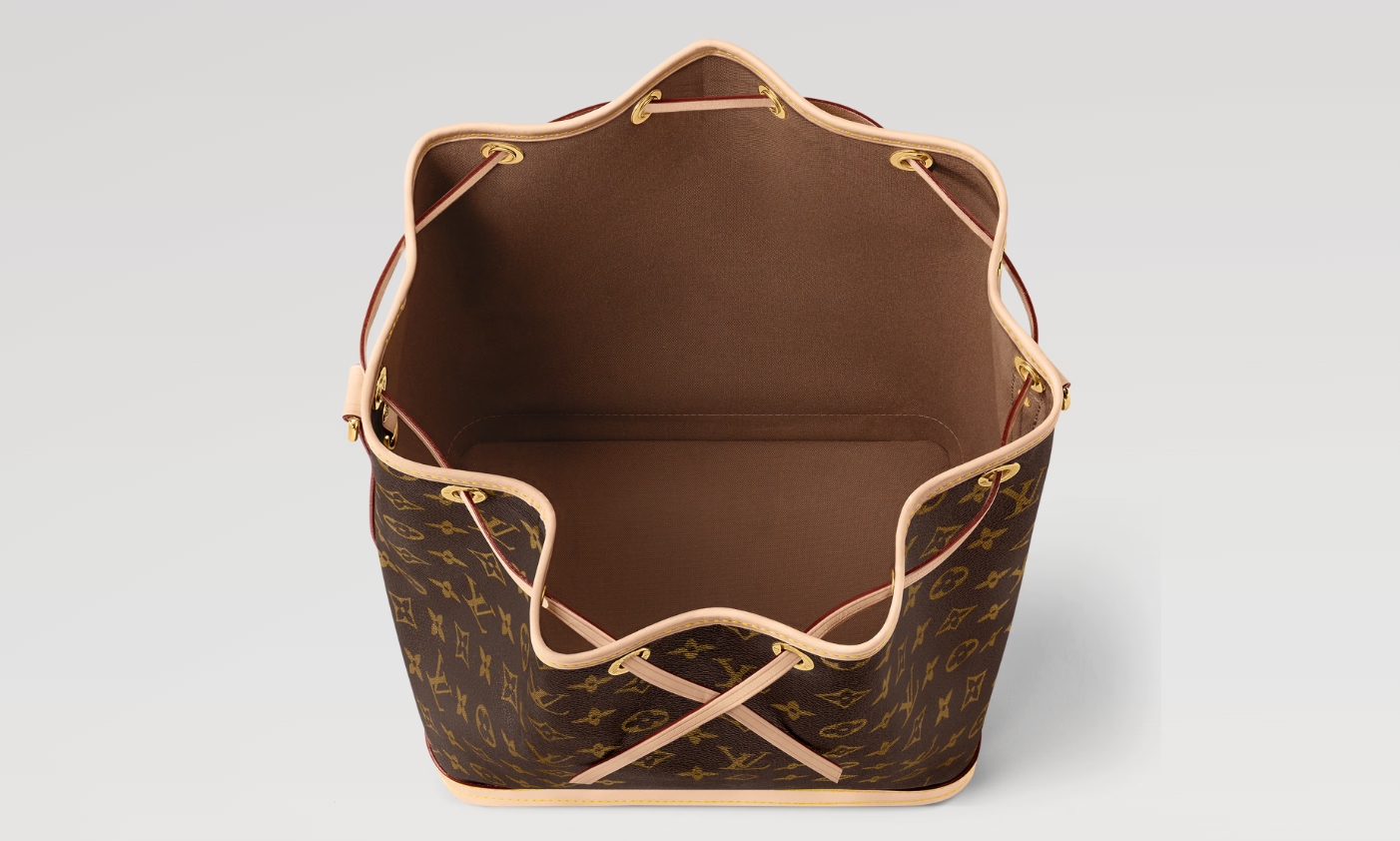
The cylindrical form of the Noé does the rest of the work. It has no corners. No dead spaces. It simply provides continuous volume, allowing the contents to settle into place under their own weight. It’s efficient in a way that feels almost invisible until you start comparing it to anything else – even bags by other designers intended for the same purpose.
And then there’s the closure—the detail most people recognize, but rarely stop to think about.

The drawstring isn’t there for style. It’s there because it solves a problem that hardware can’t. A rigid frame would introduce pressure points on the necks of the upright bottles. A clasp would limit flexibility. So instead, a leather cord was introduced for its adaptability. It cinches around whatever is inside the bag and secures it without resistance, allowing the bag to form to and move with its contents instead of constraining them in a way that might result in damage or breakage.
When you step back and consider the Noé as a whole, it stops being just another fancy handbag and starts identifying as exactly what it was from the beginning: a purpose-built piece of equipment executed with extraordinary discipline. Every element serves a function. The proportions are calibrated to support its intended load. Its structure is substantial without being excessive. The closure system is simple, effective, and direct. Every element feels considered, but none of it feels forced. That is part of what makes the Noé so compelling. It was engineered to do a very specific job, yet its purpose has transcended generations.
And here’s the rub – it carries that purpose with elegance. Even in its earliest Monogram canvas form, with natural cowhide trim, the Noé had a quiet refinement that elevated it beyond mere utility. The coated canvas delivered durability, yes, but it also carried the unmistakable visual identity of the house. The vachetta trim brought warmth, softness, and a human element to the design, aging from a pale, clean leather into something richer and more personal over time. In that sense, the Noé was never static. It performed, but it also evolved, taking on character with use in a way that made the bag feel increasingly individual to the person carrying it.
That balance is the real story. From the start, the Noé solved a practical problem with absolute clarity while also establishing the kind of confidence that only a fully realized – and time-tested – design can create. It did what it was engineered to do, and it did it so well that there has been very little reason to interfere with it since. When a design is this complete—when every decision is tied cleanly back to function—you do not need to keep reinventing it to preserve its relevance. You let it live. You let it age. You let people discover, over years and then decades, just how well it works. Nearly a century later, the Noé still stands as proof that the most enduring luxury designs are often those perfected from the very beginning.
1930s–1950s: Early Use and the First Shift in Identity

In its earliest years, the Noé remained closely tied to the role it had been created to serve. It was a travel object first and foremost—made to move contents from one place to another securely, efficiently, and without unnecessary flourish. But it did not stay confined to that purpose for long. People began using it to carry far more than champagne, and the transition feels almost inevitable in hindsight. The very qualities that made the Noé so effective in its original context—its storage capacity, its ease of accessibility, and the reassuring integrity of its structure—also made it exceptionally useful in everyday life. It could hold more than a conventional handbag, open and close with ease, and be used without the conscious restraint that often comes with owning luxury goods. Put simply, it was designed to work – and it did so while still exuding a sublime, but practical, elegance.

That practicality was matched by materials that only became more compelling with use. During this period, the Noé was produced primarily in Monogram canvas with natural cowhide trim, a combination that gave the bag both resilience and character. The canvas stood up to the elements. The leather absorbed them. Over time, the trim darkened, softened, and developed variation through handling and exposure, not as a calculated design flourish, but as a natural byproduct of use. Looking back, that evolution is part of what gives the Noé so much of its depth. The patina does more than show age. It records experience, reflects time, and turns ownership into something visible.
1960s–1980s: The Bag Becomes Part of the Wardrobe

By the 1960s, the culture around luxury had begun to loosen. Travel was becoming less ceremonial. Fashion was growing more expressive. Objects once valued purely for what they did were beginning to carry a different kind of meaning as well. The Noé, however, did not need to reinvent itself to meet that moment. It simply entered a new one. What had begun as a practical transport piece started appearing more naturally in everyday life—on city streets, in editorial imagery, and as part of wardrobes that were no longer built around formality. What made that transition so seamless was the fact that the bag already had what it needed: the right proportions, the right presence, and the right balance between structure and ease. It did not require reinterpretation because it already felt complete.
The introduction of Epi leather in the 1980s added a new dimension without disturbing that foundation. Suddenly, the same silhouette could project something different depending on the material wrapped around it. Monogram remained rooted in heritage and house identity, while Epi brought texture, color, and a sharper contemporary attitude. The form stayed the same, but the tone could shift. That is not an easy balance to maintain, yet Louis Vuitton handled it with discipline. Rather than redesigning the Noé to chase relevance, the house let the materials do the talking.
1990s–Early 2000s: Expansion Without Dilution

As Louis Vuitton expanded globally, the Noé expanded with it. It was during this period that the bag moved from being a strong heritage piece to something more universal—still grounded in its origins, but now firmly established as part of the house’s core offering. It became recognizable across markets, accessible without feeling ordinary, and consistent in a way that reinforced its value. New canvas treatments, such as Damier Ebene and later Damier Azur, broadened the bag’s appeal, but importantly, they did so without altering the bag’s structure. Louis Vuitton continued to treat the Noé as a fixed form, allowing the surface to evolve while leaving its functional elements untouched.
That approach aligned perfectly with a broader shift in consumer behavior. Luxury was no longer reserved for select occasions or formal moments. It was becoming part of daily life, and the concept of an everyday luxury bag was beginning to settle in. The Noé fit that role almost effortlessly because it did not need to be reimagined for it. It was already capable, already comfortable, already easy to live with. It carried what people needed it to carry, and it did so with the kind of simplicity that never has to announce itself. More than that, after more than sixty years of existence, the bag had become a reliable traveling companion and a well-trusted part of the LV house.
2010s: Refinement, Not Reinvention — The NéoNoé

By the 2010s, expectations around purchasing and owning luxury handbags had shifted again. Organization mattered more. Versatility mattered more. The original Noé still worked, but it came from a more open, less compartmentalized approach to carry. When Louis Vuitton introduced the NéoNoé in 2017, the house could have easily fallen into the marketing trap that derails so many brands—overexplaining the update, overworking the design, or sanding away the qualities that made the original worth preserving in the first place. It did none of that.
The NéoNoé maintains the foundational premise of the original. The silhouette remains recognizable. The drawstring remains essential. The proportions still trace back to the bag’s original purpose. What changed was the way the interior responded to contemporary use: added structure, interior compartments, a central zipped pocket, and a more adaptable strap system. In other words, Louis Vuitton refined the experience of carrying the bag without reinventing its form. The same principle holds true in the smaller formats that followed, including the Noé BB and Nano Noé. Scale, materials, and use cases change, but the silhouette maintains its identity. That consistency is precisely the point.
The Noé As a Platform: Materials, Color, and Collaboration

At a certain point, the Noé stopped being just a product in the Louis Vuitton line and began functioning as something broader: a design Louis Vuitton could build upon repeatedly, creating variations that relied on its foundational structure while pushing the bag in a more contemporary, overtly luxurious direction. By then, the silhouette was so well established and so immediately recognizable that the house began layering new ideas onto it without upsetting the underlying design. Seasonal releases, limited editions, and collaborations all found room within the Noé because the structure itself was so clearly resolved. Different materials were applied. Different colorways were introduced. Surfaces could shift, textures could change, and the bag could take on a different mood from one release to the next, all while remaining unmistakably itself.
That only worked because the original form was strong enough to support the experimentation. The Noé had become a foundational article of the House. Its proportions were fixed. Its logic was intact. Its identity did not depend on any single finish. As a result, the bag absorbed variation without feeling scattered or diluted, which was a rare quality in design. Many silhouettes began to lose themselves once too much was asked of them. The Noé did not. It could incorporate heritage materials, bold colors, or collaborative treatments, yet still return to the same essential idea. That consistency was what made the experimentation possible in the first place.
2020s: Heritage, Monogram, and the Present Moment


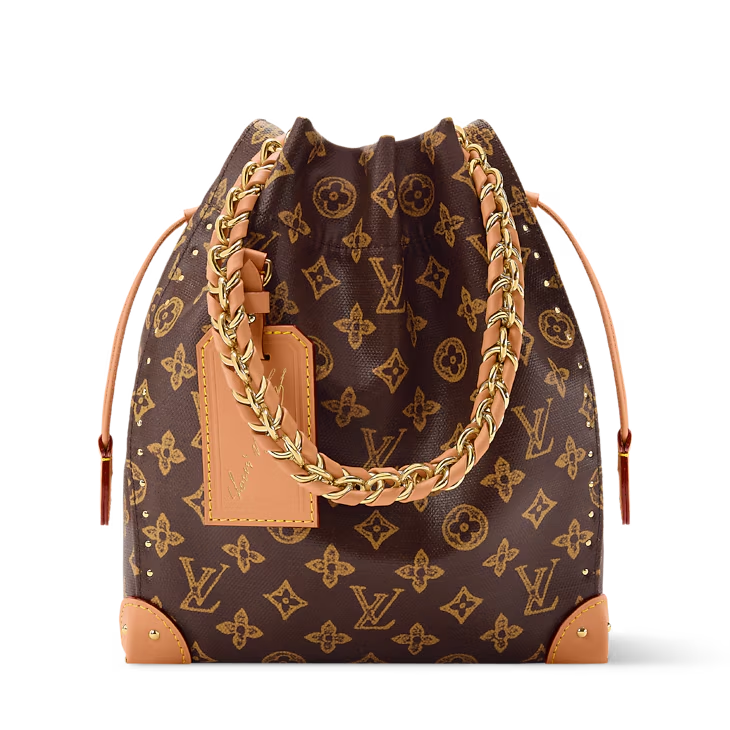
Which brings us to the present. In the current moment, Louis Vuitton has made a visible return to the foundations that built the house: Monogram, heritage materials, and the core silhouettes that continue to anchor the brand’s identity. The Noé sits comfortably at the center of that conversation because it has never needed to be rediscovered. It has simply continued. When it appears in recent Monogram-focused presentations and heritage-minded collections, it does not read like a revived archival curiosity. It reads like what it has always been—a living part of the house vocabulary.

What has changed is not the bag itself, but the way it is being framed. In a market crowded with increasingly complicated designs, louder gestures, and constant novelty, the Noé’s clarity stands out even more sharply. It feels intentional because it is intentional. It feels complete because the underlying idea was complete from the start. And importantly, none of that has made it less usable in the present. It still works the way people actually carry bags now: crossbody, over the shoulder, into daily routines, and into wardrobes that are far more dynamic (both formal and relaxed) than the ones for which it was first intended. The Noé adapts to contemporary life without asking to be redefined by it, which is a large part of why it still feels so current.
Why the Noé Still Works

The Noé still works because it has never tried to be more complicated than it needed to be. It was created to solve a specific problem, and it did so with unusual clarity. Everything that followed was built on the strength of that original silhouette. The proportions made sense. The materials made sense. The closure made sense. Every part of the bag supported the same central idea, and because of that, the design held together across decades of changing tastes and uses.
Over time, those decisions did not weaken. They compounded. The bag became easier to understand, easier to carry, easier to live with, and ultimately easier to trust. That trust was not abstract. It came from repetition. It came from use. It came from a design doing what it promised to do over and over again without needing to explain itself. That is why the Noé has remained relevant. It’s not because the design had to be constantly reimagined to change with the times, but because it was able to remain exactly as Gaston Louis Vuitton originally imagined it.
Closing: Carrying Forward
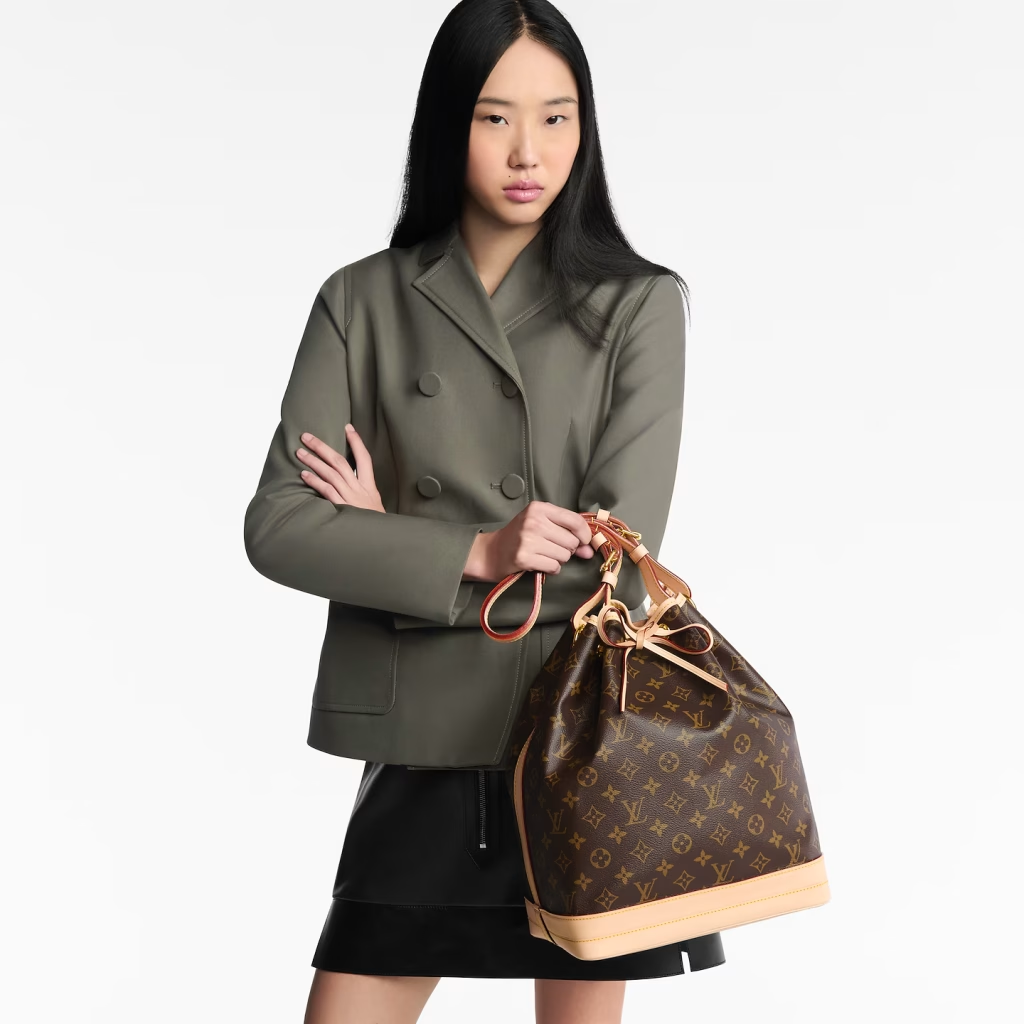
The Louis Vuitton Noé began as a bag specifically designed to carry bottles of champagne, and that origin will always matter because it explains the design’s origins. But its single purpose never defined the bag. In fact, what makes the Noé so interesting is how far it has evolved from its initial purpose without ever abandoning the logic that led to its creation. Over time, it became something rarer than a successful handbag. It became a constant.
The Noé endured for decades through cultural, stylistic, and global economic changes without surrendering its identity. It incorporated new materials, new contexts, and new expectations without compeomising ita dentity or the internal coherence that made it work in the first place. That kind of sustained longevity is not accidental, nor is it the result of clever marketing alone. It happens when the original idea is strong enough to keep propelling itself forward over time, thrilling multiple generations of consumers.
That is where the Noé still stands today—not as a passing trend, not as a nostalgic revival, and not as a silhouette begging the modern market for relevance. It survives unchanged because it earned its place in the luxury space the way few luxury bags have. What began as a precise solution to a practical problem grew, over the decades, into something far rarer: a bag that never had to abandon its original logic to become iconic. The materials changed. The context changed. Fashion changed. The Noé endured. And that endurance is the real story. It still carries what matters, still does it with clarity and ease, and still moves through the world with the kind of quiet authority only truly great design ever achieves.