Luxury watches often live in one of two worlds. Some are rooted in old-world elegance, built around centuries of tradition and quiet – and gradual – refinement. Others lean heavily into modern performance, embracing technology, sport, and innovation. Few brands have successfully managed to live in both spaces simultaneously quite like TAG Heuer.
For more than 160 years, the Swiss watchmaker has occupied a unique position within the luxury landscape. It is a company equally comfortable inside the pit lane at Monaco, on the wrist of a Hollywood icon, or displayed behind the glass counters of high-end boutiques around the world. TAG Heuer’s story is not simply about watchmaking. It is about precision engineering, motorsport culture, technological experimentation, and the relentless pursuit of speed.
Unlike some heritage brands that built their identities around royalty, aviation, or deep-sea exploration, TAG Heuer’s DNA has always been tied to fractions of a second. Racing drivers, stopwatch operators, rally navigators, and Formula 1 teams have all relied on the company’s precision timing equipment long before any of the luxury retailers began chasing motorsport partnerships. That authenticity helped shape the brand into something far more compelling than a traditional watchmaker. TAG Heuer has become an integral part of racing history itself.
Over the decades, the company introduced some of the most recognizable chronographs ever created. The Carrera became synonymous with clean racing-inspired design. The Monaco challenged traditional watch aesthetics with its bold square case. The Formula 1 collection introduced an entire generation to Swiss luxury sports watches during the quartz era. And along the way, the brand became permanently linked to icons like Steve McQueen and Ayrton Senna, while its logos appeared on race cars, timing equipment, sponsorship banners at racetracks, and championship-winning Formula 1 teams around the globe.
Today, under the broader luxury umbrella of LVMH (Louis Vuitton Moët Hennessy), TAG Heuer continues to blend heritage with modernity in a way that few brands can replicate. It remains deeply connected to motorsports while also embracing smartwatches, advanced movement technology, and contemporary luxury culture. That balance between past and present is part of what continues to make TAG Heuer so relevant more than a century and a half after its founding.
For Louis in the Wild, TAG Heuer represents more than just another luxury brand. It represents a company that understood early on that emotion, storytelling, and lifestyle could become just as important as craftsmanship itself. Much like Louis Vuitton transformed luggage into a cultural statement, TAG Heuer transformed sports timing into a symbol of ambition, movement, and performance….and for myself, whose personal passions continue to be deeply interwoven with the world of competitive driving and high-performance sports cars, the heritage and legacy of this brand is all the more alluring because of its intentional fusion of luxury and racing.
Edouard Heuer and the Birth of the Brand

The TAG Heuer story begins in 1860, when a young Swiss watchmaker named Edouard Heuer founded his company in Saint-Imier, Switzerland. He was only 20 years old at the time, but his ambition quickly became apparent. While many watchmakers of the era focused on traditional pocket watches and decorative craftsmanship, Heuer gravitated toward technical precision and mechanical innovation.
That focus helped separate his company from many of its competitors early on. Edouard Heuer recognized that accurate timing was becoming increasingly important during the industrial age. Railroads, athletic competitions, and emerging forms of transportation all required more precise methods of measuring time. Rather than simply producing elegant watches, Heuer sought to engineer solutions.

Throughout the late 19th century, the company steadily built a reputation for technical excellence. One of its most important breakthroughs came in 1887 with the patenting of the oscillating pinion, a chronograph innovation that simplified how a stopwatch’s functions engaged with the movement. More than a century later, variations of Heuer’s oscillating pinion are still found in mechanical chronographs.
That achievement established Heuer as more than a small Swiss watchmaker. It positioned the company as a genuine innovator in horology, laying the groundwork for the precision-timing legacy that would later define the brand’s connection to motorsports.
Charles-Auguste Heuer and Timing Beyond the Racetrack

As Edouard Heuer’s company continued to grow during the late 19th century, the business increasingly became a family-driven pursuit. One of the most important figures in that evolution was Charles-Auguste Heuer, Edouard’s son, who was born in 1868 and would eventually help expand the company’s technical ambitions far beyond traditional watchmaking. While his father established the foundation through precision chronographs and mechanical innovation, Charles helped push the brand into new professional and scientific applications during the early 20th century.
By this point, accurate timing was becoming essential across a wide range of industries, not just transportation and sport. Doctors, scientists, engineers, and industrial professionals all needed increasingly precise ways to measure short intervals of time. Charles-Auguste recognized that chronograph technology could serve practical medical purposes as effectively as it served race drivers and athletes. That realization led to one of the more fascinating — and often overlooked — innovations in the company’s early history.

In 1908, Heuer patented the Sphygmometer pocket chronograph, a medical timing instrument designed specifically for physicians. The watch featured a colorful graduated dial scale that allowed doctors to quickly calculate a patient’s pulse rate after counting heartbeats for only 20 seconds, rather than requiring a full minute count. It was an elegant example of practical engineering applied to medicine, demonstrating how far the company’s timing expertise had evolved under Charles-Auguste’s leadership. Long before TAG Heuer became synonymous with Formula 1 and racing chronographs, the Heuer family was already proving that precision timing could play an important role in everyday life, science, and healthcare.
Precision Timing and the Rise of Motorsport

As the 20th century began, automobiles and aviation were rapidly transforming the modern world. With transportation – and by proxy, speed – becoming increasingly important, possessing accurate timing instruments suddenly mattered more than ever….and Heuer was perfectly positioned to capitalize on that demand.
The company, still known as Edouard Heuer & Compagnie through the 1920s, began producing stopwatches, dashboard timers, and precision timing equipment for sporting events and the transportation industry. Rally racing, endurance competitions, and early Grand Prix events all relied heavily on accurate timekeeping, and Heuer became one of the most respected names in the field.
In 1929, the company introduced the now-iconic HEUER shield, a bold Art Deco-inspired mark that placed the family name inside a strong geometric frame. It was simple, confident, and immediately recognizable—exactly the kind of visual identity a precision timing company needed as its instruments moved deeper into cars, aircraft, racetracks, and professional timing environments. Long before the TAG name was added decades later, the HEUER shield became the company’s defining signature, and it remains one of the most recognizable emblems in modern watchmaking.
This period helped establish one of the defining relationships in luxury watch history: the bond between Heuer and motorsports. Unlike many modern sponsorships that are largely image-driven, Heuer’s involvement in racing grew organically from necessity. Drivers and teams genuinely depended on the company’s instruments.

By the 1930s, Heuer timers had become fixtures inside race cars and aircraft cockpits. The company’s Autavia dashboard instrument — combining the words “automobile” and “aviation” — became especially respected for its reliability and readability under pressure. It was a functional tool first and foremost, but it also laid the foundation for one of the company’s future wristwatch icons.
Jack Heuer and the Reinvention of the Brand

If Edouard Heuer established the company’s technical identity, Jack Heuer helped define its modern personality.
Jack was not an outsider brought in to modernize the business. He was part of the Heuer bloodline itself: the great-grandson of founder Edouard Heuer and a direct descendant of the same family legacy carried forward by Charles-Auguste Heuer in the early 20th century. By the time Jack entered the company in the late 1950s, Heuer already had nearly a century of credibility behind it. The challenge was different now. The company did not simply need to make accurate timing instruments. It needed to make them desirable in a faster, more visual, more media-driven world.
Jack joined the family business at a moment when automobiles, aviation, and organized sport had already shaped Heuer’s reputation. But he understood something important: motorsport was becoming more than a technical proving ground. Formula 1, endurance racing, and rallying were evolving into glamorous international spectacles filled with celebrities, wealthy sponsors, factory teams, and global audiences. He saw an opportunity to align the Heuer brand directly with that world—not as a decorative sponsor, but as a legitimate timing partner with deep roots in the sport.
That perspective helped change the direction of the company. Jack modernized Heuer’s design language and embraced aggressive sports marketing at a time when many luxury watchmakers still relied on more conservative, traditional advertising methods. His approach felt contemporary, youthful, and performance-driven. He understood that a chronograph could be more than a tool. In the right context, it could become part of the identity of the person wearing it.
He also understood the importance of clean, functional design. Racing drivers needed watches that were easy to read at speed, under pressure, and in environments where distraction was not an option. That philosophy directly influenced the development of some of the most important chronographs in the company’s history. Under Jack Heuer, the brand did not abandon the precision-first values established by Edouard and carried forward by Charles-Auguste. It translated them for a new generation—one defined by speed, style, sponsorship, and the rising mythology of motorsport.
The Autavia Becomes a Wristwatch

In 1962, Jack brought the Autavia name to the wrist, creating what TAG Heuer identifies as the company’s first chronograph with a true collection name. That distinction is important. Heuer had made wrist chronographs before, but the Autavia gave the company something more defined: a model with a clear identity, a professional backstory, and a direct connection to the worlds of speed and performance. It was not just another timing device. It was a named Heuer chronograph with a purpose.
The Autavia wristwatch also showed Jack Heuer’s gift for translating the company’s instrument-making heritage into something more modern and wearable. Its rotating bezel, strong legibility, and purposeful design made it feel like a natural evolution of the dashboard timers that had carried the same name decades earlier. In that sense, the Autavia helped bridge old Heuer and new Heuer—linking the company’s professional timing roots to the more emotionally charged sports chronographs that would soon define the brand.
The Carrera and the Birth of a Racing Icon

Introduced in 1963, the Carrera quickly became one of the defining racing chronographs of the 20th century. Jack Heuer reportedly drew inspiration from the Carrera Panamericana, the famously dangerous Mexican road race whose name carried exactly the qualities he wanted for the watch: speed, danger, elegance, and international appeal. It was short, memorable, and powerful. More importantly, it sounded like it belonged in motion.
The watch itself embodied those same qualities. Unlike many chronographs of the era, which could feel crowded with scales, numerals, and competing information, the Carrera was designed around clarity. Its dial layout was remarkably clean, with sharp legibility, balanced subdials, and minimal visual clutter. It was purpose-built for drivers, navigators, and serious timing work, where elapsed time needed to be read quickly and confidently under pressure.

That restraint became part of the Carrera’s genius. Jack Heuer understood that good racing design did not need to shout. The watch had to be functional first, but it also had to look modern, composed, and technically sophisticated. Its strong case design, clean dial architecture, and motorsport connection gave the Carrera a personality that felt both professional and aspirational. It was not merely a stopwatch adapted for the wrist. It was a racing chronograph with a clear design philosophy.
Over time, the Carrera evolved from a professional timing instrument into one of the cornerstone collections of modern luxury sports watches. Vintage examples remain highly collectible today, particularly among enthusiasts who appreciate the early manual-wind models and their direct connection to Heuer’s golden age of motorsport. Modern Carreras continue to carry that same DNA while incorporating contemporary movements, materials, case construction, and finishing.

Few watches better represent TAG Heuer’s overall identity. The Carrera is sporty without feeling oversized or cartoonish. It is elegant without losing its racing roots. More than 60 years after its debut, it remains one of the purest expressions of motorsport-inspired watch design—and one of the clearest examples of Jack Heuer’s ability to turn precision timing into something emotionally resonant.
The Monaco and Steve McQueen’s Lasting Influence

If the Carrera represented refinement and racing utility, the Monaco represented rebellion.
Introduced in 1969, the Monaco immediately stood apart thanks to its square case design — something almost unheard of in luxury sports watches at the time. It also housed one of the world’s first automatic chronograph movements, making it technologically important in addition to visually striking.
But the Monaco’s legend truly exploded in 1971, when Steve McQueen wore the watch during filming for Le Mans. McQueen was already deeply associated with cool, masculine style and authentic racing culture. His decision to wear the Monaco transformed the watch into a cultural icon almost overnight.

The blue-dial Monaco worn by Steve McQueen remains one of the most recognizable watches ever produced. Its square case, deep blue dial, red accents, and left-side crown gave it a shape and personality that immediately stood apart from traditional chronographs. Even people with little knowledge of horology often recognize the Monaco silhouette, largely because Le Mans fixed the watch in the public imagination as part of McQueen’s larger image: cool, focused, understated, and unmistakably tied to racing.
That cultural staying power says a great deal about TAG Heuer as a brand. The company has consistently found ways to take technical products—chronographs, dashboard timers, race instruments, and precision timing tools—and give them emotional weight. In the Monaco’s case, the watch became more than an automatic chronograph. It became an object tied to aspiration, adventure, identity, and the enduring mythology of motorsport.
Heuer Accelerates Into Formula One

By 1969, Heuer’s connection to motorsport had moved well beyond instrument panels and timing equipment. Through its sponsorship of Swiss Formula One driver Jo Siffert, the company became the first non-automotive logo to appear on a Formula One car. It was a major moment for the brand, and a smart one. Heuer was no longer just supplying the tools used around racing; it was putting its name directly into the sport’s visual language.
That relationship gave Heuer an authenticity that traditional advertising could not manufacture. Siffert was not simply a celebrity endorsement. He was a legitimate racing figure, and his association with Heuer helped connect the brand to the drivers, teams, and fans who saw Formula One as the highest expression of speed and precision. For Jack Heuer, it was exactly the kind of organic brand alignment he understood so well: a timing company linked to a world where every fraction of a second could define a result.


Heuer’s Formula One presence grew even stronger two years later when the company became a sponsor of the Ferrari Formula One team. Drivers including Mario Andretti, Jacky Ickx, Niki Lauda, Clay Regazzoni, and Gilles Villeneuve would all be associated with Heuer chronographs, further strengthening the brand’s reputation inside the paddock. Jack Heuer also presented each of these Ferrari drivers with an 18-karat gold Heuer Carrera, turning the watch into more than a timing instrument. It became a badge of achievement, worn by some of the most important names in motorsport.
Formula 1, Techniques d’Avant Garde (TAG), and Ayrton Senna

By the 1970s and 1980s, Heuer’s relationship with motorsport had become inseparable from the company’s identity.
The brand continued to partner with Ferrari during one of Formula 1’s most dangerous and charismatic eras, appearing alongside legendary drivers like Niki Lauda and Clay Regazzoni. These partnerships felt authentic because the company remained heavily involved in timing technology and race instrumentation, not just sponsorship visibility.
In 1985, the company entered a new phase when Techniques d’Avant Garde — TAG — acquired Heuer. TAG already held strong connections to Formula 1 through its involvement with McLaren and Porsche-developed turbo engines. The newly formed TAG Heuer embraced a more modern, aggressive marketing style that perfectly aligned with the high-tech image of 1980s motorsport.

Few partnerships became more important than the company’s relationship with Ayrton Senna. When Senna joined McLaren, he entered one of the most dominant and intensely watched chapters in Formula 1 history, and TAG Heuer was already visually connected to that world through its relationship with the team. Senna brought something different to the brand. He was not just fast; he was analytical, obsessive, emotional, and almost impossibly precise. For a watch company built around timing, performance, and the pursuit of fractions of a second, the association felt natural.
Senna became closely linked with the TAG Heuer S/el, short for “Sports Elegance,” a collection introduced in 1987 as one of the first major watch lines developed under the TAG Heuer name. The S/el was designed to be more upscale than the company’s earlier dive-watch-driven catalog, blending everyday wearability with a more refined, technical look. TAG Heuer’s own history notes that Senna wore the S/el as his everyday watch, and that he contributed to the development of its distinctive bracelet design. That detail is important because it makes the relationship feel more personal than a simple endorsement. Senna was not merely photographed with the product; he became part of the watch’s story.

Between 1989 and 1993, Senna was often seen wearing TAG Heuer S/el chronographs, including models with the collection’s now-familiar S-shaped bracelet. Those watches became visual shorthand for TAG Heuer’s late-1980s and early-1990s identity: technical, modern, performance-minded, and closely tied to Formula 1 at its absolute peak. The S/el later evolved into what we know today as the TAG Heuer Link, which gives the Senna connection even more long-term significance inside the company’s product history.
Even after Senna’s death in 1994, the relationship did not fade. TAG Heuer continued to honor him through special edition watches, many of which carried design cues tied to his era, his racing identity, or the S/el and Formula 1 lines that helped define the brand during those years. For collectors and racing enthusiasts, the Senna editions are not just commemorative watches. They represent one of the most emotionally powerful partnerships in modern motorsport, linking TAG Heuer to a driver whose name still stands for discipline, courage, precision, and absolute commitment.
The Quartz Era and the Formula 1 Collection

The quartz crisis dramatically reshaped the Swiss watch industry during the 1970s and 1980s. Many traditional watchmakers struggled to compete against inexpensive Japanese quartz technology, and some disappeared entirely. For Heuer, the period was especially challenging because the company had built its reputation on mechanical chronographs and precision timing instruments, just as the market was shifting toward affordable electronic accuracy.
TAG Heuer adapted more effectively than many of its competitors by embracing quartz movements while maintaining its sports-oriented identity. Rather than treating quartz as a threat to the brand’s credibility, the company used it to reach a broader audience. The watches remained connected to speed, timing, durability, and modern design, but they became more accessible to younger buyers entering the luxury market for the first time.

The Formula 1 collection became especially significant during this period. Introduced after the TAG acquisition, these watches were bold, colorful, durable, and unmistakably tied to racing culture. With their quartz movements, bright cases, rubber straps, and energetic design language, early TAG Heuer Formula 1 models felt perfectly aligned with the 1980s. They were not traditional dress watches pretending to be sporty. They were intentionally youthful, technical, and performance-minded.
For many enthusiasts, a TAG Heuer Formula 1 served as their first Swiss luxury watch. That accessibility helped broaden the brand’s audience dramatically and kept TAG Heuer visible at a time when many Swiss brands were retreating into exclusivity. While others leaned heavily into heritage and high-end mechanical watchmaking, TAG Heuer found a different path: it stayed connected to motorsports, embraced modern materials and quartz technology, and kept the brand within reach of a new generation of buyers.
TAG Heuer in the Modern Luxury Era

In 1999, TAG Heuer entered a new chapter when leading French luxury-goods group LVMH Moët Hennessy Louis Vuitton acquired the company. The move placed TAG Heuer within one of the world’s most powerful luxury groups, alongside brands such as Louis Vuitton, Hublot, and Zenith. It also gave the company a deeper global reach, stronger luxury positioning, and the resources to expand without losing the motorsport identity that had defined it for generations.
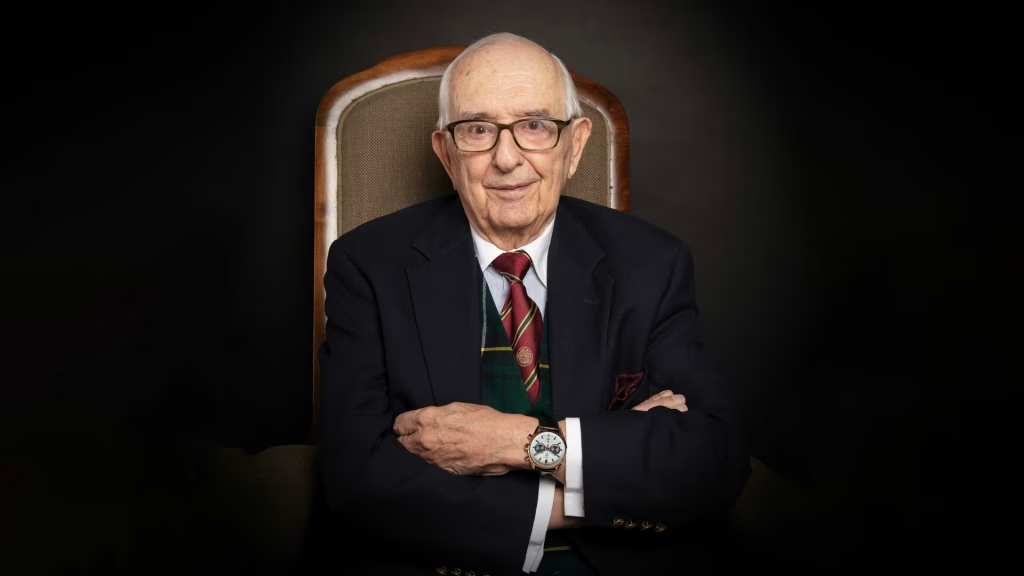
Just as importantly, Jack Heuer returned to the company in 2001 as Honorary Chairman. Jack had been forced to sell the family business in 1982, making his return deeply symbolic. He became a living connection between the company’s mid-century golden age and its modern future, appearing around the world to share the Heuer story with collectors, journalists, retailers, and a new generation of enthusiasts. His presence helped remind people that TAG Heuer was not simply a luxury brand with racing imagery. It was a company with a real family lineage, a genuine technical past, and a direct connection to the people who had shaped modern sports chronograph design.
Today, TAG Heuer operates within the LVMH luxury empire, yet despite the enormous changes within the luxury industry over the past several decades, it has managed to retain its core identity remarkably well. It remains one of the few watch brands that can speak credibly to mechanical innovation, motorsport culture, accessible luxury, and mainstream recognition without feeling like it has abandoned the personality that made it famous.
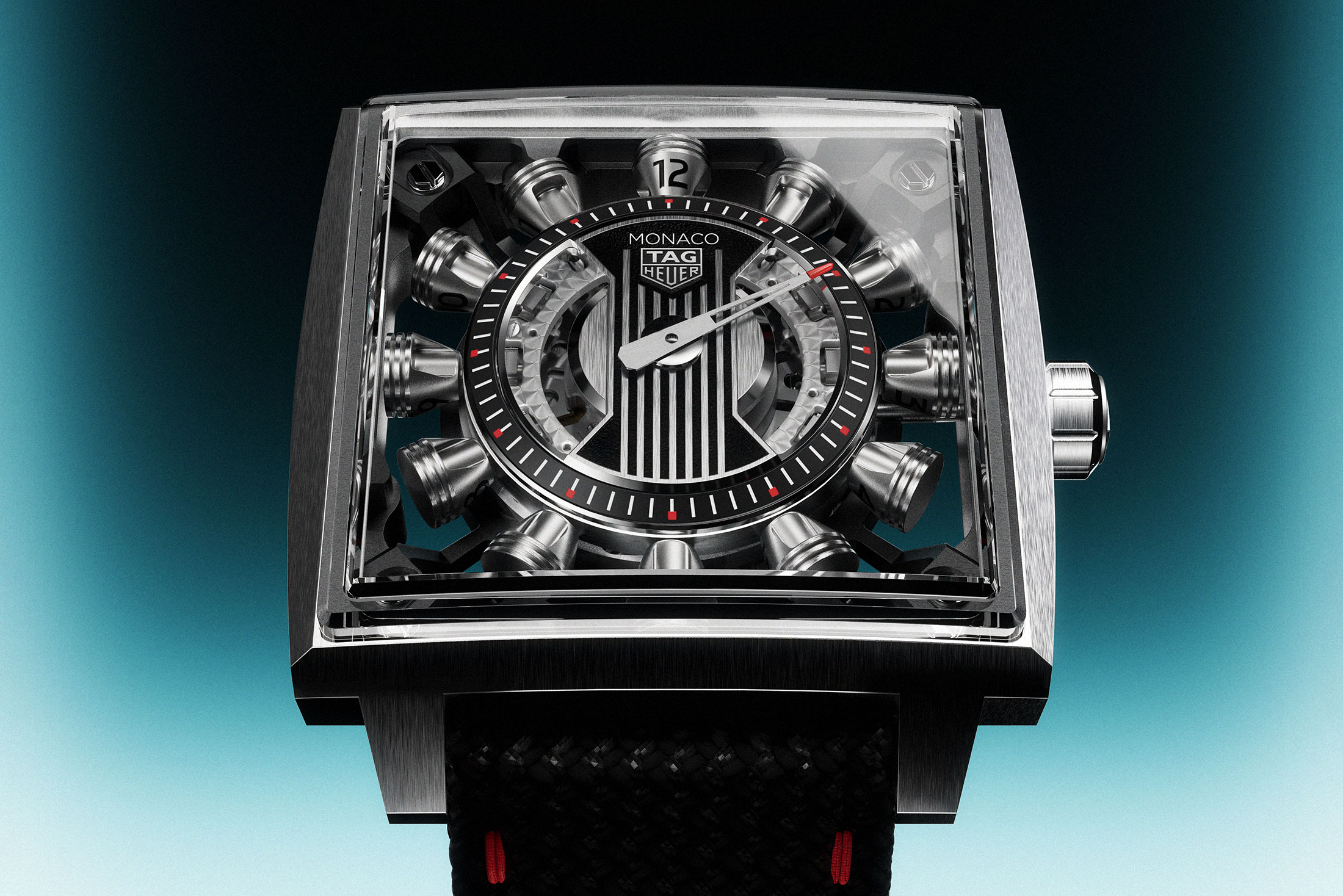
The company continues producing modern versions of the Carrera, Monaco, and Autavia while also pushing into newer territory through connected smartwatches and advanced movement technologies. Experimental projects like the Monaco V4 showcased that willingness to rethink traditional watchmaking architecture entirely. Unveiled as a concept at Baselworld in 2004, the Monaco V4 used mechanical transmission belts and a linear winding system, proving that TAG Heuer was still willing to challenge convention rather than simply repackage its greatest hits.

That modern identity is not limited to chronographs. The Aquaracer has become one of the company’s most important contemporary collections, giving TAG Heuer a strong presence in the dive-watch category. Introduced as the Aquaracer line in 2004, the collection traces its roots back to Heuer’s first dive watches of the late 1970s and early 1980s. It broadened the brand’s everyday appeal by giving buyers a clean, durable, water-ready sports watch that could sit comfortably beside the Carrera and Monaco without competing directly with them.
At the same time, TAG Heuer continues leaning heavily into its racing heritage through Formula 1 partnerships, endurance racing sponsorships, and collaborations tied to automotive culture. One of the most important modern examples is the TAG Heuer Carrera x Porsche partnership, which formally united two brands that had long shared the Carrera name. Porsche drew its Carrera identity from the Carrera Panamericana road race, the same legendary event that inspired Jack Heuer to name the Carrera chronograph in 1963.

That combination of heritage and modernity remains one of the company’s greatest strengths. TAG Heuer understands its past, but it does not feel trapped by nostalgia. The brand can celebrate Jack Heuer, Steve McQueen, Ayrton Senna, Niki Lauda, Jo Siffert, Ferrari, Porsche, Monaco, and Carrera while still building modern watches that feel relevant to new buyers. That balance is difficult to maintain, and TAG Heuer has done it better than most.
Why TAG Heuer Still Resonates Today

More than 160 years after Edouard Heuer founded his small workshop in Switzerland, TAG Heuer remains one of the most recognizable names in luxury watchmaking. That longevity is not accidental. The company survived because it kept adapting while protecting the central idea that made Heuer important in the first place: precision timekeeping built for people who live close to speed, pressure, and performance.
The company succeeded because it built its identity around something timeless: the human fascination with speed, precision, and competition. Racing culture continues to captivate audiences because it represents ambition pushed to its limits. TAG Heuer found a way to bottle that energy into wearable form. Whether through the Carrera, Monaco, Autavia, Formula 1, Aquaracer, or its Porsche collaborations, the brand has consistently turned technical watches into objects with story, personality, and emotional pull.
For collectors, enthusiasts, and newcomers alike, TAG Heuer remains far more than a watch company. It is one of the rare luxury brands that still feels genuinely connected to motion, risk, innovation, and human ambition. Its best watches do not simply tell time; they carry the energy of the racetrack, the discipline of engineering, and the confidence of a brand that has spent more than 160 years chasing precision. That is why TAG Heuer continues to resonate. It does not just preserve history. It keeps finding new ways to make that history feel alive.
This story is dedicated to my dear friends Don and Daina, whose enthusiasm for luxury timepieces opened a world to me that I might otherwise never have discovered. They understood me well enough to know that my love of racing, sports cars—especially Corvettes—and performance driving would make TAG Heuer feel personal in a way few other watch brands could. Their encouragement ultimately led me to purchase my first TAG Heuer, but the gift they really gave me was an introduction to a world of craftsmanship, history, design, and motorsport heritage that I have come to deeply appreciate. I am grateful every day for that introduction, and even more grateful for their continued friendship.