When TAG Heuer and Louis Vuitton Built a V12 for the Wrist
There are collaborations created primarily to combine two recognizable names, and then there are collaborations in which one partner contributes something the other simply could not have produced alone.
The TAG Heuer Monaco Speed 12 belongs firmly in the second category. It is not merely a familiar watch dressed in collaborative branding, nor is it a limited edition timepiece defined only by a new colorway, commemorative inscription, or shared campaign. Its significance comes from the fact that the watch itself could only exist through the combination of two distinct watchmaking identities.
Introduced during the 2026 Formula 1 Louis Vuitton Grand Prix de Monaco, the Speed 12 brings together two very different branches of the LVMH watchmaking family. TAG Heuer supplied the Monaco, its most recognizable case, with more than half a century of motorsport credibility, and a design philosophy rooted in speed and mechanical performance. La Fabrique du Temps Louis Vuitton supplied one of modern high watchmaking’s most distinctive complications: the patented Spin Time display.
The result is neither a conventional TAG Heuer Monaco nor a Louis Vuitton watch wearing another company’s name. Each Maison remains clearly represented, yet neither overwhelms the other. The Monaco provides the visual identity, motorsport character, and architectural framework, while La Fabrique du Temps contributes the advanced mechanical concept that allows the watch to display time in an entirely different way.
By combining TAG Heuer’s most recognizable racing watch with one of Louis Vuitton’s most distinctive high-watchmaking innovations, the Speed 12 reimagines the Monaco as a mechanical evocation of a twelve-cylinder engine for the wrist.
Identifying the Correct Watch

The name requires some clarification because “TAG Heuer Monaco Speed 12” can easily be mistaken for a reference to one of TAG Heuer’s earlier movements.
This is the TAG Heuer Monaco Speed 12, reference WBW2180.FT8133. It should not be confused with the Monaco Calibre 12, a family of conventional automatic chronographs produced during an earlier chapter of the collection’s history. Although the names sound related, the watches are fundamentally different in both purpose and construction.
The Speed 12 does not use the former TAG Heuer Calibre 12. It is not a chronograph, and it does not rely on conventional hour or seconds hands to communicate the time. Aside from the central minute hand, nearly everything about its display departs from the familiar Monaco formula.
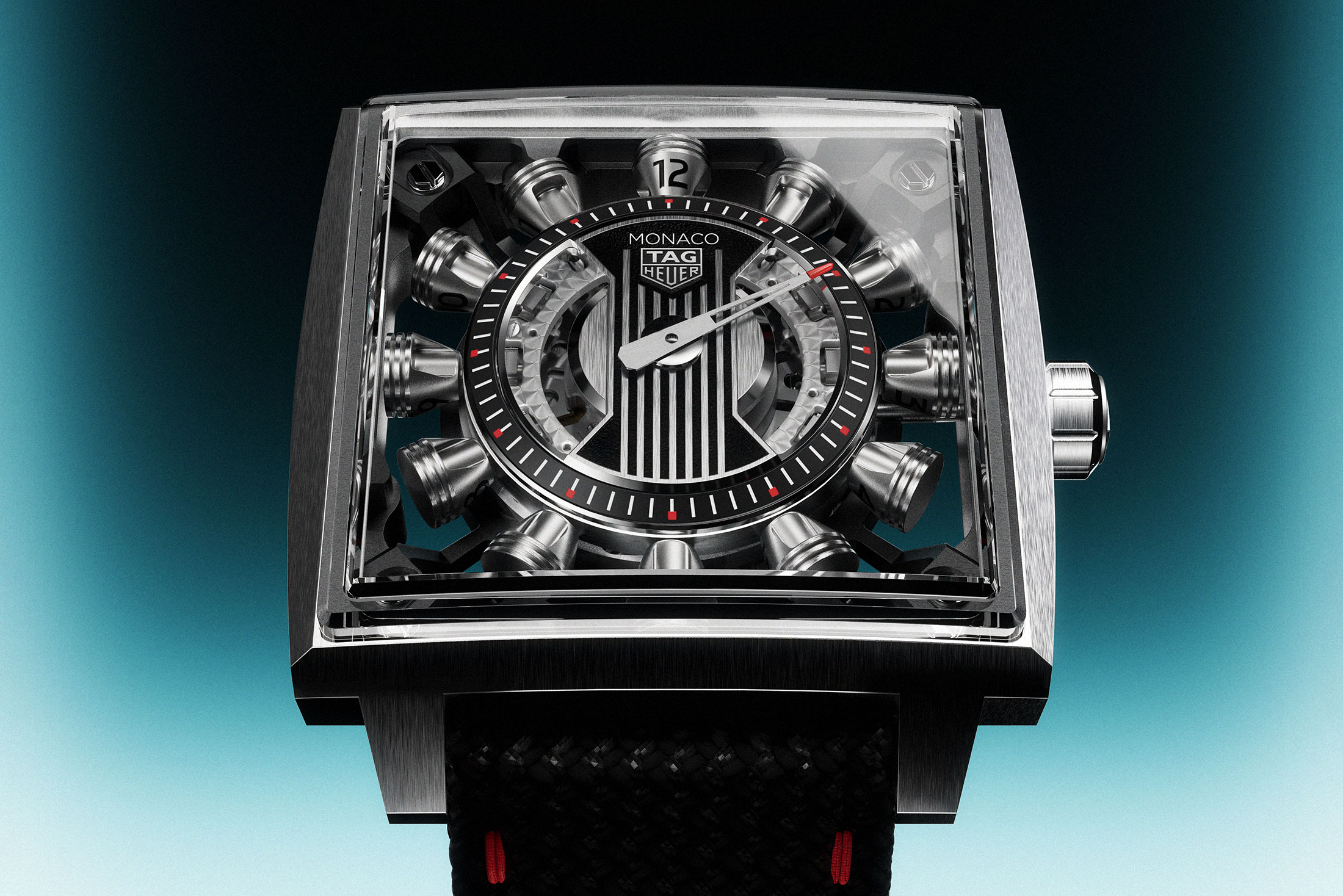
Instead, the name refers to the twelve piston-shaped indicators arranged around the dial. Each one represents an hour, and together they form a jumping-hour display inspired by the visual rhythm, symmetry, and mechanical character of a twelve-cylinder performance engine.
That distinction is central to understanding the watch. The number 12 describes the architecture of the display rather than the movement lineage, and the word “Speed” speaks more to the watch’s automotive identity than to any timing function.
TAG Heuer did not simply skeletonize another Monaco chronograph or apply a motorsport-themed dial to an existing movement. The company replaced the Monaco’s familiar method of displaying time with an entirely different mechanical architecture—one in which the passage from hour to hour becomes part of the watch’s visual performance.
The Monaco as an Experimental Platform
The Monaco was unconventional from the beginning. Its identity was built not around restraint or tradition, but around the willingness to challenge the accepted shape, construction, and visual language of a performance watch.
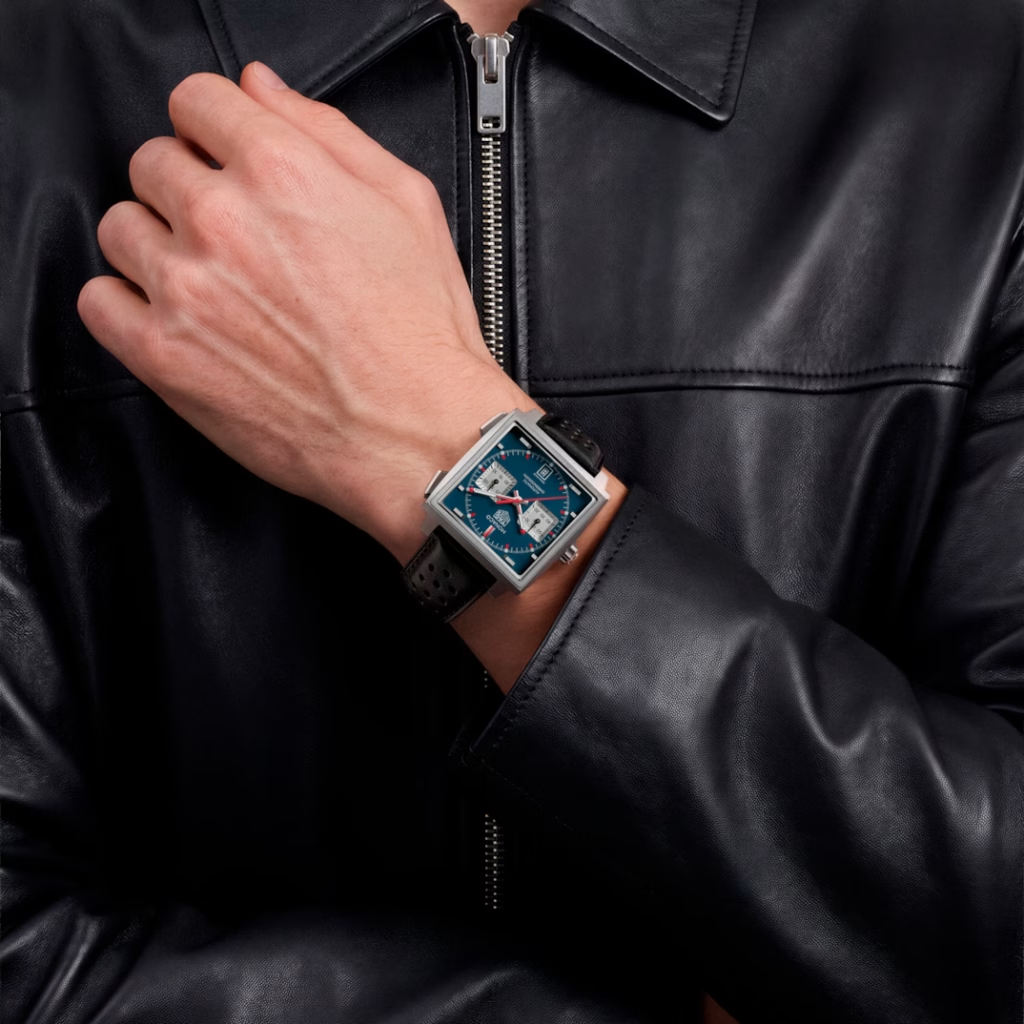
When Heuer introduced it in 1969, its square case, left-side crown, and automatic chronograph movement challenged nearly every assumption about what a sporting wristwatch was supposed to look like. At a time when most chronographs remained round and comparatively conservative, the Monaco appeared architectural, modern, and deliberately disruptive. Its subsequent appearance on Steve McQueen’s wrist in Le Mans transformed it into a cultural symbol, but the watch’s importance has always extended well beyond that association.
The original Monaco was an engineering statement before it became a movie icon. Its fame may have been amplified by Hollywood, but its lasting significance was established by the technical ambition and visual confidence of the watch itself.
That history makes the collection particularly well suited to experimental watchmaking. TAG Heuer has repeatedly used the Monaco as a platform for ideas that would appear too radical, too mechanical, or too visually disruptive inside a more traditional case. Its square architecture has become a kind of laboratory—one in which the brand can explore new ways of building, displaying, and interacting with time.
The belt-driven Monaco V4 replaced conventional movement architecture with miniature transmission belts, borrowing directly from automotive engineering. The Monaco Split-Seconds brought an advanced rattrapante chronograph into a transparent, highly technical interpretation of the square case. The Monaco Evergraph explored a compliant mechanism intended to rethink how a chronograph could be constructed and operated.
Each of those watches approached the Monaco differently, but all shared the same underlying purpose: to demonstrate that the collection could remain relevant by continuing to challenge convention rather than simply repeating its past.
The Speed 12 continues that trajectory.
It does not attempt to recreate the blue dial and white registers of the original Monaco, nor does it rely solely on nostalgia to justify its place in the collection. Instead, it returns to the more fundamental idea behind the 1969 watch: the Monaco should be the place where TAG Heuer takes risks, tests new mechanical concepts, and questions what a performance watch can become.
La Fabrique du Temps Louis Vuitton

The mechanism at the center of the Speed 12 comes from La Fabrique du Temps Louis Vuitton, the Geneva-area high-watchmaking manufacture founded by master watchmakers Michel Navas and Enrico Barbasini. Within the wider LVMH watchmaking structure, the atelier has become known for developing technically ambitious movements that combine traditional complication-making with unconventional methods of displaying time.
La Fabrique du Temps has created tourbillons, minute repeaters, automata, and other grand complications, but its most recognizable invention is arguably Spin Time. Rather than treating time as something shown only by hands moving across a flat dial, Spin Time turns the hour display into a three-dimensional mechanical performance.
The original concept replaces a conventional hour hand with twelve rotating cubes positioned around the perimeter of the dial. Each cube carries an hour numeral on one of its faces. At the beginning of a new hour, the previously active cube turns to conceal its numeral while the next cube rotates to reveal the current hour.
The two indicators move almost simultaneously, creating a rapid and visually precise transition from one hour to the next. What would normally occur through the quiet movement of a hand becomes an identifiable mechanical event that the wearer can see unfold.
It is a form of jumping-hour display, but one executed with three-dimensional components distributed around the dial rather than through a conventional aperture. That architecture gives the complication both its technical identity and its distinctive visual presence.
For the Monaco Speed 12, those familiar Spin Time cubes were transformed into piston-shaped indicators. The underlying principle remains recognizable, but the components were reimagined to connect the complication directly to TAG Heuer’s motorsport language and the mechanical character of the Monaco.
Reading the TAG Heuer Monaco Speed 12

The time display appears unusual at first, largely because the Speed 12 abandons nearly every visual convention associated with a traditional wristwatch. Once its layout is understood, however, reading it becomes surprisingly straightforward.
A single central hand indicates the minutes against a black opaline minute ring positioned around the movement. Its skeletonized construction keeps the mechanism beneath it visible, while its red-lacquered tip recalls the needle of an automotive instrument or competition gauge.
The current hour appears on one of the twelve rotating pistons surrounding the dial. Only the active piston reveals its numeral, allowing the eye to identify the hour without searching through a conventional ring of printed markers.
When the minute hand reaches the top of the hour, the active piston rotates back to its neutral position while the next piston turns 90 degrees to reveal its black-lacquered Arabic numeral. The exchange occurs rapidly, creating the impression that one mechanical component is handing responsibility to the next.
At ten minutes past ten, for example, the piston positioned at ten o’clock displays the number 10 while the central hand indicates ten minutes. When the hand completes its revolution, that piston closes and the eleven o’clock piston rotates into view, announcing the beginning of the next hour.
The complication therefore turns every hourly transition into a visible mechanical event. Rather than allowing time to advance almost unnoticed, the TAG Heuer Monaco Speed 12 gives the wearer a brief moment of motion and interaction at the top of every hour.
There is no seconds indication and no chronograph. Despite the Monaco’s racing heritage, the Speed 12 is not intended to measure a lap time or record elapsed seconds. Its purpose is different: to transform the ordinary passage from one hour to the next into a carefully choreographed piece of kinetic theater.
Twelve Pistons, Not Twelve Cylinders

TAG Heuer describes the Speed 12 through the imagery of a twelve-cylinder engine, but the watch does not attempt to reproduce a literal combustion engine in miniature. The inspiration is expressed through form, arrangement, and mechanical rhythm rather than through a direct recreation of cylinders, connecting rods, or reciprocating components.
Its twelve rhodium-plated indicators resemble pistons, complete with stepped surfaces and contrasting brushed and sandblasted finishes. Arranged radially around the center of the movement, they create the impression of a highly compact mechanical powerplant suspended inside the square Monaco case.
The indicators do not move vertically in the manner of pistons inside an engine. Instead, each one rotates through 90 degrees to reveal or conceal its hour numeral as the display advances.
The automotive connection is therefore conceptual rather than mechanically literal. The watch borrows the visual language of performance engineering without pretending that its movement operates like an internal-combustion engine.
That distinction strengthens the design. The TAG Heuer Monaco Speed 12 avoids becoming a novelty watch by resisting the temptation to place a miniature working engine on the wrist. Instead, it uses recognizable automotive forms to communicate the function and movement of a legitimate horological complication.
The piston shape therefore does more than provide a visual theme. It transforms the established Spin Time architecture into something that feels specific to TAG Heuer, giving the mechanism a motorsport-driven identity that belongs naturally within the Monaco collection.
An Engine Suspended Inside a Chassis

The relationship between the circular movement and the square Monaco case is one of the Speed 12’s strongest visual features. Rather than attempting to force the mechanism into the geometry of the case, TAG Heuer allows the contrast between the two shapes to become part of the design.
Four black DLC-coated, openworked arches occupy the corners of the case. These structural elements appear to suspend the round movement within the square Grade 5 titanium chassis, much like an engine mounted securely inside a vehicle frame. The arrangement gives the watch a sense of mechanical tension, as though the central assembly is being held in place by four precisely engineered supports.
The open construction leaves considerable negative space around the movement and piston indicators. That space is not decorative; it allows light to pass through the architecture and gives the wearer a clearer view of the individual components. Rather than disguising the mechanical module beneath a conventional dial, TAG Heuer places it almost entirely on display.
At the center of the watch, vertically aligned grooves recall the ribbed covers found on high-performance engines. The TAG Heuer shield sits above the central minute hand, framed by the Monaco name and the strong architectural lines surrounding the mechanism. These details give the movement a recognizable visual center without interrupting the openness of the composition.
Red accents are used sparingly and with clear purpose. They appear on the lacquered tip of the minute hand, at five-minute intervals around the track, and in the stitching of the strap. The restraint is important. A greater amount of red could easily have pushed the watch toward theatrical excess or made the automotive theme feel too literal.
Instead, the predominant palette remains titanium silver, black, and white. The limited use of color allows the finishing, structure, and movement architecture to carry the design, preserving the Speed 12’s technical character while giving it the visual discipline expected of contemporary high watchmaking.
The Calibre TH84-00

The TAG Heuer Monaco Speed 12 is powered by the automatic Calibre TH84-00, developed and manufactured by La Fabrique du Temps Louis Vuitton and adapted specifically for TAG Heuer. It is the technical foundation of the watch, supporting both its unconventional display and the automotive-inspired architecture built around it.
The movement operates at 28,800 vibrations per hour, or 4 Hz, a frequency widely associated with stable and precise modern mechanical timekeeping. It contains 35 jewels, provides approximately 45 hours of power reserve, and supports two principal functions: jumping hours and centrally displayed minutes.
Its automatic winding system is visible through the sapphire caseback, allowing the wearer to observe the movement and its finishing from the reverse side. The oscillating weight incorporates the profile of the TAG Heuer shield, giving the calibre a recognizable brand-specific detail while reinforcing that the movement was developed for this particular project rather than selected from a generic catalogue.
The mechanism retains the essential architecture of Louis Vuitton’s Spin Time complication, but its presentation has been substantially reworked. The familiar rotating cubes have been replaced by the Monaco’s twelve piston-shaped indicators, while the surrounding bridges, supports, finishing, and display elements were redesigned to suit the watch’s performance-driven character.
This is therefore not simply a Louis Vuitton movement placed unchanged inside a TAG Heuer case. The display, component geometry, surface treatments, and surrounding architecture were all adapted to express TAG Heuer’s motorsport language and to integrate naturally with the Monaco’s square form.
The underlying complication and its intellectual property come from La Fabrique du Temps Louis Vuitton. The way that complication has been interpreted, styled, and presented, however, belongs specifically to the Monaco Speed 12. The Calibre TH84-00 is where the collaboration becomes most tangible: Louis Vuitton’s high-watchmaking expertise expressed through the visual and mechanical identity of TAG Heuer.
Grade 5 Titanium and Sapphire

The Monaco Speed 12 measures 40 millimeters across and is manufactured from Grade 5 titanium, a material chosen not only for its technical properties but also for the precision with which it can be shaped and finished.
Grade 5 titanium combines low weight with considerable strength, allowing the Speed 12 to maintain the structural presence expected of a Monaco without feeling unnecessarily heavy on the wrist. Its hardness also permits TAG Heuer to execute the case’s sharply defined planes, openworked corners, and angular transitions with a high degree of precision.
Finely brushed, polished, and sandblasted surfaces are used throughout the case to distinguish its individual structural elements. The contrasting treatments emphasize the Monaco’s geometry, catch the light differently across each surface, and prevent the predominantly monochromatic construction from appearing visually flat.
The square architecture remains unmistakably Monaco, but the exposed corners, sapphire components, and suspended movement give the Speed 12 a character unlike that of a conventional watch case. It appears less like a protective shell surrounding a movement and more like a piece of mechanical infrastructure engineered to support and display it.
A fixed sapphire bezel and domed sapphire crystal provide an unobstructed view into the mechanism from the front. At the rear, a second sapphire crystal exposes the Calibre TH84-00, the shield-shaped rotor, and the reverse side of the twelve-piston assembly. Together, the two transparent surfaces allow the watch’s internal architecture to be appreciated from nearly every angle.
The case is water-resistant to 30 meters.
That rating provides protection against ordinary incidental contact with moisture, but it also makes the Speed 12’s intended role clear. This is a high-complication collector’s piece rather than a conventional sports watch designed for demanding aquatic or trackside use.
The Monaco name may be rooted in motorsport, but this particular Monaco is built to showcase engineering rather than endure pit-lane abuse.
The Strap
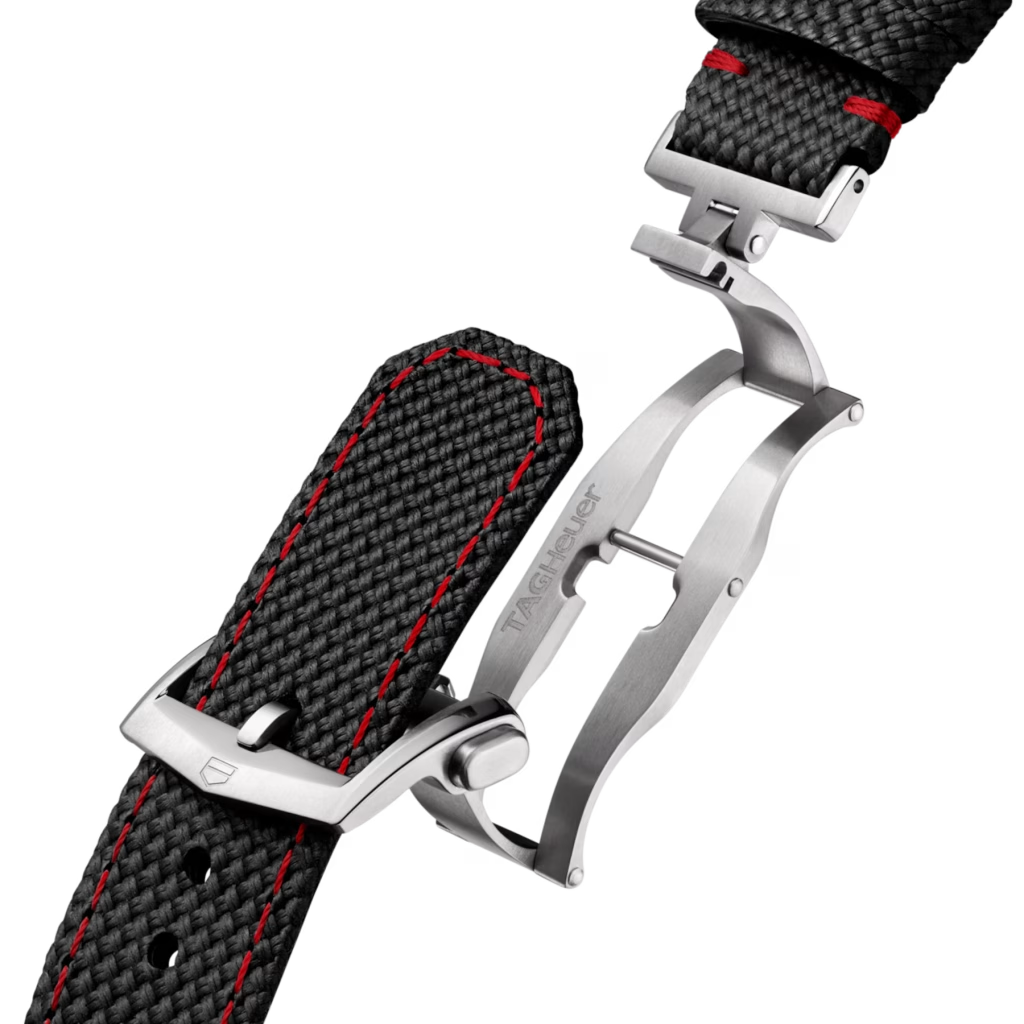
The Monaco Speed 12 is fitted to a black rubber strap embossed with a textile-like pattern, giving it the visual texture of woven fabric while preserving the flexibility and durability associated with a technical rubber construction.
Red hand-stitching runs along its edges, echoing the restrained red accents found on the dial and minute hand. The detail provides just enough contrast to connect the strap with the watch head without drawing attention away from the exposed movement.
A Grade 5 titanium folding clasp with double safety push-buttons secures the watch. Its lightweight construction complements the titanium case, while the dual-release system provides a reassuringly precise and secure closure.
The material choice is particularly well judged. A traditional alligator strap would have shifted the Speed 12 toward a more formal expression of high watchmaking, while an integrated titanium bracelet could have added visual weight and competed with the complexity of the case.
The rubber strap keeps the watch modern, technical, and firmly connected to TAG Heuer’s performance-oriented identity. At the same time, its embossed surface and hand-finished stitching give it enough refinement to feel appropriate on a watch of this mechanical and financial stature.
Rather than becoming another focal point, the strap supports the design quietly, allowing the suspended movement and piston display to remain the undisputed center of attention.
More Than Corporate Cross-Promotion

The Speed 12 is especially significant within the larger LVMH structure because it transforms the Group’s relationship with Formula 1 from a collection of complementary partnerships into a tangible piece of collaborative watchmaking.
LVMH began its ten-year global partnership with Formula 1 in 2025, bringing several of its most recognizable Maisons into the sport under one long-term agreement. Each entered the relationship with a distinct identity and purpose: Louis Vuitton through its trophy trunks, travel heritage, and the symbolism of victory; TAG Heuer through official timekeeping and its deep-rooted connection to motorsport; and Moët Hennessy through the rituals of celebration that accompany success on the world stage.
At Monaco in 2026, those individual relationships became unusually concentrated.
Louis Vuitton provided the name and much of the broader luxury presence surrounding the Grand Prix. TAG Heuer celebrated both its renewed position within Formula 1 and its longstanding association with the Monaco circuit. Behind the watch itself, La Fabrique du Temps Louis Vuitton supplied the advanced complication that made the weekend’s most technically ambitious timepiece possible.
The Speed 12 is therefore more than a watch unveiled at an LVMH-sponsored event. Its connection to the Group extends beyond timing, branding, hospitality, and trackside visibility.
It is a physical example of the capabilities LVMH can unlock when its Maisons share genuine expertise rather than merely appearing beside one another on a sponsorship board. The collaboration moves from the commercial environment surrounding Formula 1 into the architecture of the watch itself.
TAG Heuer receives access to one of the Group’s most distinctive high-watchmaking mechanisms and the specialized knowledge required to produce it. La Fabrique du Temps receives a new platform through which to demonstrate the adaptability of its Spin Time architecture. Louis Vuitton’s watchmaking expertise reaches an audience that may be far more familiar with the Monaco, TAG Heuer, and Formula 1 than with the Tambour or the complications traditionally associated with La Fabrique du Temps.
Importantly, none of the participants disappears inside the collaboration.
TAG Heuer retains the case, the motorsport character, and the visual language of the finished watch. La Fabrique du Temps retains the mechanical sophistication and fundamental operating principle of Spin Time. Louis Vuitton’s broader connection to the event provides the setting in which those capabilities come together.
Each participant remains identifiable, but the resulting product could not have existed in the same form without all of them. That makes the Monaco Speed 12 something more meaningful than an LVMH-branded Formula 1 release: it is evidence of what the Group can create when shared ownership becomes shared capability.
Fifty Watches. One Very Clear Statement.
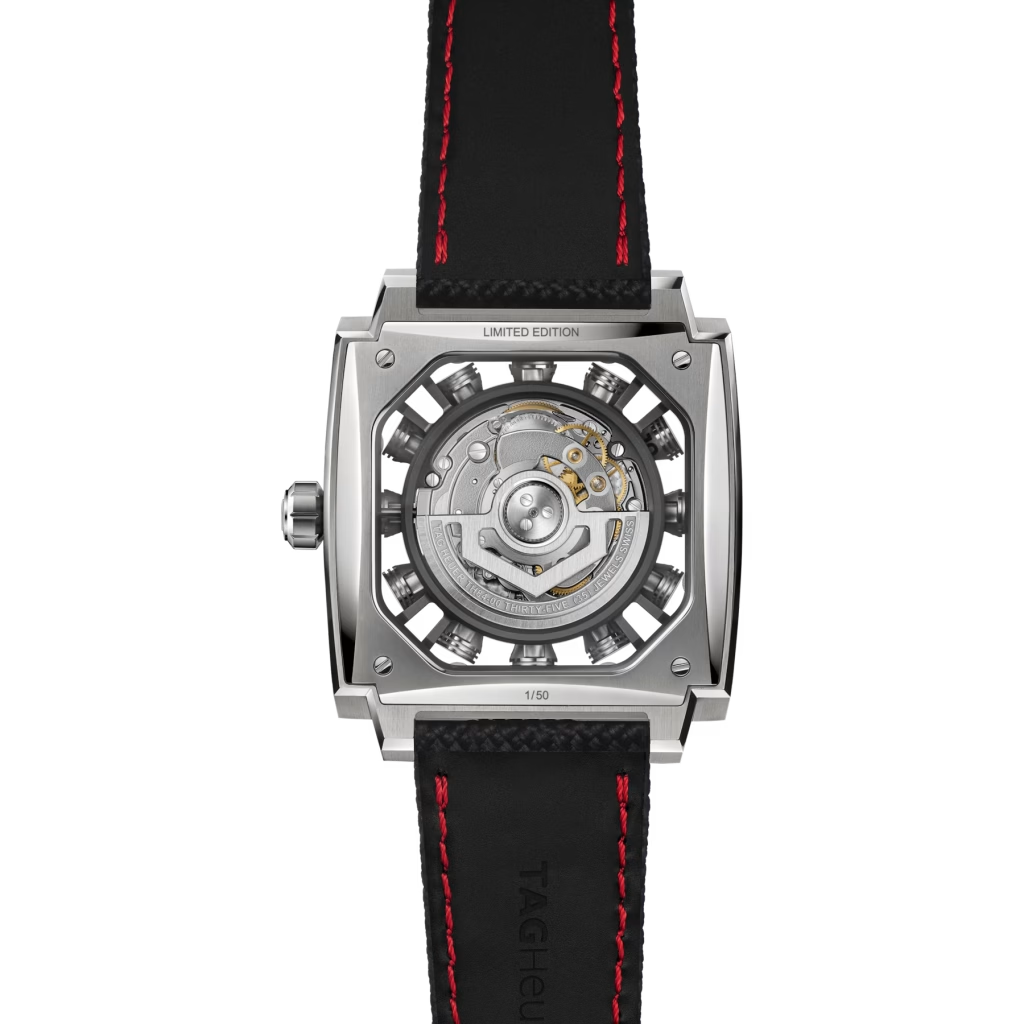
Only 50 examples of the Monaco Speed 12 will be produced, each individually numbered and visible through a sapphire caseback that leaves almost nothing hidden.
That scarcity matters, but it is not the most important thing about the watch.
The Speed 12 was never intended to become another broadly available Monaco variation or a commemorative edition distinguished primarily by color, engraving, or historical reference. Its limited production reflects the complexity of the mechanism, the specialized manufacturing behind it, and the unusual level of collaboration required to bring it to life.
At approximately $87,000, it also occupies a dramatically different position from the conventional Monaco chronograph. This is not simply a more expensive version of an existing watch. It is a piece of contemporary haute horlogerie built inside one of motorsport’s most recognizable cases.
The Speed 12 asks collectors to view the Monaco differently—not only as an icon of the past, but as a platform capable of carrying TAG Heuer into an entirely new mechanical category.
The Monaco Is Still Doing What It Was Built to Do

The original Monaco became important because it refused to look or behave like the watches around it. Its significance was rooted not in conformity, but in the confidence to challenge what a modern sports watch could be.
Its square waterproof case, automatic chronograph movement, left-side crown, and unapologetically modern design made it one of the most radical sporting watches of 1969. At a time when most chronographs remained round and comparatively traditional, the Monaco looked architectural, technical, and deliberately unconventional. Steve McQueen later gave it cultural immortality, but the watch had already established its place through engineering, visual audacity, and a willingness to reject accepted rules.
More than half a century later, the Speed 12 returns to that same spirit. It does not simply borrow the Monaco’s shape; it embraces the philosophy that made the original so disruptive.
It does not attempt to recreate McQueen’s watch. It does not depend upon a blue dial, white registers, or another retelling of Le Mans to establish its relevance. Instead, it takes the Monaco’s most fundamental characteristic—its refusal to follow convention—and carries that idea into a new mechanical era.
The result is not a chronograph, despite emerging from one of history’s most famous chronograph families. It does not measure elapsed time, record a lap, or place conventional timing functions at the center of its identity. Instead, it transforms the arrival of each new hour into a mechanical event, with twelve rotating pistons performing beneath a sapphire crystal like components inside an exposed engine.
The Monaco Speed 12 is expensive, scarce, technically extravagant, and entirely unnecessary in the practical sense.
That excess is part of its purpose.
Watches such as this are not created because the world needs another way to tell time. They are created to demonstrate what imagination, engineering, craftsmanship, and institutional knowledge can accomplish when practical limitations are temporarily set aside. They show how far a familiar design can evolve without losing the qualities that made it recognizable in the first place.
The Speed 12 succeeds because it does not treat the Monaco as a historical object that must be preserved unchanged. It treats it as a living platform—one still capable of carrying new ideas, new mechanisms, and new expressions of performance.
In 1969, the Monaco challenged the accepted shape of a sports watch.
In 2026, the Speed 12 challenges what a Monaco can be.
More than fifty years after the original rewrote the rules, TAG Heuer’s square icon is once again operating at the edge of expectation—only now, it is firing on all twelve.
Verified specifications
| Detail | TAG Heuer Monaco Speed 12 |
|---|---|
| Reference | WBW2180.FT8133 |
| Case | 40 mm Grade 5 titanium |
| Finishing | Fine-brushed, polished and sandblasted |
| Bezel | Fixed sapphire |
| Crystals | Domed sapphire front; sapphire display back |
| Movement | Automatic Calibre TH84-00 |
| Manufacture | La Fabrique du Temps Louis Vuitton |
| Display | Rotating piston jumping hours; central minutes |
| Frequency | 28,800 vph / 4 Hz |
| Power reserve | Approximately 45 hours |
| Jewels | 35 |
| Water resistance | 30 meters |
| Strap | Textile-embossed black rubber with red hand-stitching |
| Clasp | Grade 5 titanium folding clasp |
| Production | 50 individually numbered pieces |
| Announced availability | December 2026 |
| Reported US launch price | Approximately $87,000 |
The official TAG Heuer listing confirms the reference, titanium construction, automatic movement, 45-hour reserve, 4 Hz frequency, 30-meter rating and 50-piece production. The caseback imagery and independent launch specifications identify the 35-jewel count, while multiple launch reports consistently list December 2026 availability and the CHF 70,000 / €77,000 / $87,000 pricing structure.