Louis Vuitton did not come to New York quietly.
On May 20, 2026, the French luxury house presented Nicolas Ghesquière’s Cruise 2027 collection inside The Frick Collection, turning one of Manhattan’s most refined Gilded Age spaces into a full-blown collision of art, fashion, celebrity, and cultural power. Officially, Louis Vuitton framed the fashion show as its Cruise 2027 presentation, hosted in New York City, and scheduled to start at 6 p.m. Eastern time. Unofficially, this year’s show felt like something larger: a carefully staged reminder that Louis Vuitton remains one of the few houses capable of pulling fine art, street culture, Hollywood, K-pop, museum patronage, and handbag obsession into a collaborative, immersive experience that was equal parts avant-garde design fused with some of the House’s most iconic silhouettes.
This was also a very New York kind of Louis Vuitton moment, and every piece of it felt deliberately chosen. The Frick brought the old-money grandeur: polished galleries, Gilded Age architecture, and the kind of Upper East Side refinement that instantly framed the evening as something more elevated than a standard runway presentation. Keith Haring brought the downtown voltage, adding a jolt of pop-art energy, street-level history, and unmistakable New York attitude to the collection’s most talked-about pieces. The celebrities brought the flashbulbs, with Vuitton’s ambassadors, muses, and A-list friends turning the front row into its own fashion event before the first look appeared. Ghesquière brought the clothes, building a collection around the tension between uptown elegance and downtown irreverence. And the bags, naturally, may be what many clients are already circling on their wish lists, especially with a Keith Haring-infused drop expected to arrive later this year.
The Front Row Was Its Own Fashion Moment


Before a single model stepped out, the celebrity arrivals had already done their job. Louis Vuitton’s front row was stacked with the kind of star power that turns a runway show into a global conversation: Zendaya, Jennifer Connelly, Emma Stone, Cate Blanchett, Anne Hathaway, Emily Blunt, Amy Adams, Alicia Vikander, HoYeon, Chase Infiniti, Chloë Sevigny, Misty Copeland, Ava DuVernay, Felix of Stray Kids, and others were reported among the evening’s guests. Vogue, Harper’s Bazaar, The Zoe Report, Just Jared, and MEGA all highlighted the depth of the guest list, with the show reading less like a fashion event and more like a living Louis Vuitton campaign.
That celebrity mix was not random. Louis Vuitton has become particularly good at building a front row that works on multiple levels. Zendaya brings modern star wattage and a global fan base. Jennifer Connelly brings long-term Ghesquière credibility. Emma Stone brings Hollywood polish and an established Vuitton relationship. HoYeon, Felix, Chase Infiniti, and Alysa Liu represent the newer cultural lanes Louis Vuitton is cultivating: film, music, sport, and digital-era fandom, all dressed in monogrammed authority.

Zendaya, predictably, became one of the night’s headline stories. She arrived in a silvery Louis Vuitton mini dress with sculptural bell sleeves and matching silver pumps, then changed after the show into Look 14 from the Cruise 2027 runway: a cropped black motorcycle jacket paired with canary yellow satin boxer shorts. That second look was smart, sharp, and very Zendaya. It also did exactly what Louis Vuitton needed it to do: it turned a runway look into a viral celebrity moment almost immediately after it appeared on the catwalk.
Jennifer Connelly’s presence carried a different kind of weight. She is not just another famous face in Vuitton. She has long been associated with Ghesquière’s world, stretching back through his design vocabulary and into Louis Vuitton’s current women’s campaigns. Louis Vuitton’s own Spring-Summer 2026 collection page identifies Connelly as a House Ambassador, while recent fashion coverage has described her as one of Ghesquière’s longest-running muses. That kind of continuity gives a show like this added authority; it reminds longtime observers that the designer’s Louis Vuitton universe has depth, not just spectacle.
Emma Stone, meanwhile, played the role she often plays for Louis Vuitton: elegant, understated, and fully aligned with the house. She has been connected to the brand as an ambassador since 2017 and remains one of its most visible Hollywood women. Alongside Connelly and Zendaya, Stone helped bridge Vuitton’s past, present, and future.

Then there were the newer faces. Chase Infiniti, named a Louis Vuitton House Ambassador in late 2025, sat among the evening’s high-profile guests, while HoYeon, who became a Louis Vuitton global ambassador after the explosive rise of Squid Game, added another layer of international visibility. Felix of Stray Kids brought the K-pop gravitational pull that luxury brands continue to court with increasing seriousness. This was not just a front row. It was Vuitton’s cultural network, assembled in real time.
And in one of the show’s more charming surprises, Alana Haim made her runway debut, while her sisters Este and Danielle Haim were seated nearby. That little crossover between music, film, and fashion fit the night perfectly. Louis Vuitton was not simply showing clothes. It was showing how broad its world has become.
The Frick Collection Gave the Show Its Upper East Side Soul

The setting did a lot of heavy lifting.
The Frick Collection is not a neutral fashion venue. It is one of New York’s great Gilded Age mansions, the former home of industrialist Henry Clay Frick, and now a museum known for European paintings, sculpture, and decorative arts. The museum recently reopened after a major renovation by Selldorf Architects and Beyer Blinder Belle, and Louis Vuitton’s Cruise 2027 presentation marked one of the first major post-renovation fashion events inside the Frick’s restored spaces.
But Louis Vuitton’s relationship with the Frick goes far deeper than the glamor and spectacle of the Cruise 2027 event. In May 2026, the museum announced a three-year sponsorship by Louis Vuitton, making the House a principal cultural sponsor of the Frick from 2026 through 2028. The partnership provides funding for three major special exhibitions, supports art historical research through a new two-year Louis Vuitton Curatorial Research Associate position, and sponsors one year of the museum’s free public evening program, now titled “Louis Vuitton First Fridays.”
From June 2026 through May 2027, these “First Friday” evenings offer free admission from 5:30 to 9:00 p.m. on the first Friday of each calendar month, except January and September, with after-hours gallery access, talks, live music, refreshments, and art-making activities.

That makes the Cruise 2027 show feel less like a luxury house simply borrowing a beautiful room and more like the beginning of a broader cultural exchange. Louis Vuitton used the Frick as a runway setting, but it also attached its name to the museum’s public programming, exhibition schedule, and scholarly work. For a collection built around the tension between heritage and contemporary energy, that larger partnership gave the evening a more substantial foundation.
Inside, the house treated the building with the kind of visual sensitivity that keeps luxury from looking heavy-handed. Designer Marie-Anne Derville created custom seating for different galleries, including deep green benches inspired by the West Gallery’s wall coverings, dark gray seating tied to the Reception Hall, and gunmetal and aluminum chairs in other spaces. The Garden Court featured marble-like wooden benches and a white floral installation, while music by Peaches, Tepr, and Daniel Pemberton gave the presentation an unexpected pulse.
The Frick also gave the collection its central tension. Ghesquière has always loved locations with architectural and historical charge. He previously staged Louis Vuitton Cruise shows at the TWA Flight Center at JFK, the Miho Museum near Kyoto, the Salk Institute in San Diego, Park Güell in Barcelona, and the Palais des Papes in Avignon. In New York, the Frick allowed him to work with a setting that was deeply polished, deeply historic, and deeply uptown.
That uptown polish was only half the story. The other half was downtown New York, and that is where Keith Haring entered the room.
Nicolas Ghesquière’s New York: Uptown, Downtown, and Completely Vuitton

Ghesquière’s Cruise 2027 collection was built around contrast. Vogue’s Nicole Phelps reported that the designer first visited New York in 1989 as an 18-year-old fashion assistant at Jean Paul Gaultier, and that the city left a lasting impression on him. For this collection, he returned to the idea of New York as a place of split identities: uptown and downtown, fine art and street art, old wealth and youthful energy, polish and rebellion.
That theme could have become obvious in lesser hands. Ghesquière made it feel strange, layered, and expensive in the best possible way.

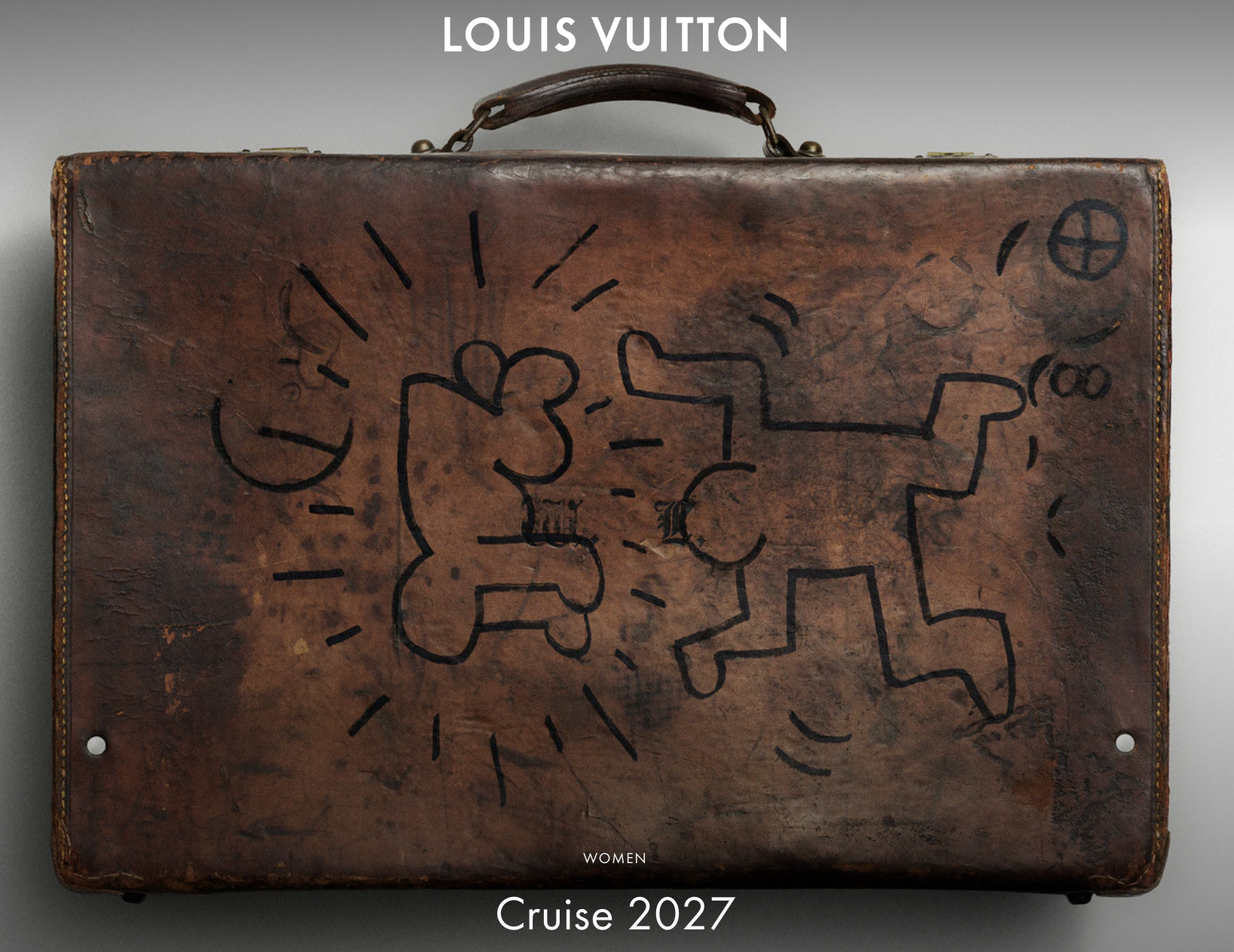
The key object was a vintage Louis Vuitton suitcase that New York street artist Keith Haring had customized in 1984 with his unmistakable black-line figures. Vogue reported that the piece was acquired by Louis Vuitton for its archive in 2020 after selling at Bonhams for about $35,000. It was used to promote the show and was carried in the opening look, immediately tying the collection to Vuitton’s travel heritage, Haring’s downtown art language, and the house’s long-running fascination with artist collaborations.
That suitcase is exactly the kind of object Vuitton loves: archival, rare, culturally loaded, and almost impossible to replicate. It connects to the house’s deepest identity as a maker of trunks and travel goods, while also tapping into the collectible energy that surrounds Vuitton’s best artist collaborations. Vogue rightly connected the Haring moment to several of the brand’s earlier collaborations with Stephen Sprouse, Takashi Murakami, Richard Prince, Julie Verhoeven, and others. The line from Sprouse’s graffiti monogram to Haring’s dancing figures is not accidental. It is Vuitton communicating one of its most successful design languages.

The clothes translated that idea into a wardrobe that moved between Upper East Side grandeur and downtown irreverence. Vogue described a mix that included Edwardian ruffles with spandex, skirt suits with short shorts, satin boxer shorts with leather race-car jackets, folded minis, lace, cut-out flowers, and floral jacquard silk faille that echoed the Frick’s own decorative interiors. There were also denim overalls, cardigans, sculptural shoulders, angular waists, headwear, and pieces that carried Haring’s graphic influence through bold lines and color.
The collection was not minimal. It was not luxury in the traditional, conventional sense. It was cultivated, playful, and occasionally bizarre, which is very much part of Ghesquière’s appeal at Louis Vuitton. He has never been interested in dressing women as though they are background characters in someone else’s life. His Vuitton woman often looks like she has a destination, a secret, a suitcase, and a better reservation than everyone else.

The Guardian reported that Ghesquière described the collection’s starting point as the “New York friction between uptown and downtown,” and that friction showed up everywhere. The Frick supplied the old-world frame. Haring supplied the street-level charge. The collection pitted denim against silk, ruffles against athletic pieces, and pop-art graphics against museum-grade surroundings.
The result was not a costume party version of New York. It was more interesting than that. It was New York as Louis Vuitton sees it: glamorous, contradictory, commercial, artistic, loud, private, public, and always aware of who is watching.
The Deeper Meaning Behind Louis Vuitton’s Keith Haring Moment

Keith Haring deserves to be understood as far more than a visual reference point for Louis Vuitton’s Cruise 2027 collection. Born in 1958 and shaped by New York’s downtown scene after moving to the city in 1978, Haring turned the subway system into a living gallery, filling blank advertising panels with chalk drawings that made art immediate, public, and accessible. His radiant babies, barking dogs, dancing figures, and pulsing black lines became part of the city’s visual language, but they also carried something deeper: joy, urgency, social conscience, and the belief that art did not have to be locked inside museums to have cultural power.
That public spirit is what made Haring’s work so important during the 1980s. He created more than 50 public works between 1982 and 1989, many tied to charities, hospitals, children’s programs, and social causes; his Crack Is Wack mural became a New York landmark, while other projects addressed literacy, anti-drug messaging, children’s welfare, sexuality, inequality, and AIDS awareness. After being diagnosed with AIDS in 1988, Haring established the Keith Haring Foundation in 1989 to support AIDS organizations and children’s programs, a mission that continues today through grants to nonprofits involved in AIDS/HIV education, research, and care, as well as organizations helping children.
That is why Louis Vuitton’s use of Haring’s work carries more cultural significance than a simple art-fashion collaboration. Haring’s imagery is beautiful, graphic, and instantly recognizable, but it is also rooted in New York street life, public access, queer history, activism, and the fight to make art serve people beyond the gallery wall. In the context of Cruise 2027, his work gives Nicolas Ghesquière’s collection a cultural backbone: the Frick supplied the uptown grandeur, but Haring supplied the human pulse of the city. Celebrating him through Vuitton only works if that larger story is carried with it — not just the bold lines and dancing figures, but the generosity, urgency, and public-minded spirit behind them.
The Keith Haring Pieces Are Going to Be the Collector Conversation


For many Louis Vuitton clients, the central question is already obvious: what will actually be available, and when can they buy it?
Louis Vuitton has not yet published a complete retail catalog, pricing structure, or official boutique arrival date for the Cruise 2027 collection. As of now, the official Louis Vuitton site is presenting Cruise 2027 as a show to watch, not yet a shoppable collection. That means any buying guidance has to be framed as an early expectation, not a confirmed retail fact.
That said, the runway and early reporting give us a strong sense of what clients should be watching. The most important pieces will almost certainly be the Keith Haring-connected bags and accessories.
There is no denying that Keith Haring’s artwork has direct, unmistakable ties to New York City’s 1980s-era street culture. But its significance goes much deeper than that.
The Guardian reported that the collaboration will include a classic Louis Vuitton Speedy reissued with Haring’s dancing babies and barking dogs. The Zoe Report also noted Haring imagery on Alma and Speedy bags, as well as on shift dresses, tops, jackets, shoes, and earrings. PurseBop similarly identified reworked classic Vuitton silhouettes, including the Speedy and Alma, as part of the collection’s Haring story.
That is where this drop may get very dangerous for collectors.


The Speedy is already one of Louis Vuitton’s most recognizable handbags, and when Vuitton places a major artist language onto a familiar silhouette, history tells us people pay attention. The Sprouse graffiti bags became defining early-2000s collectibles. Murakami’s Monogram Multicolore and Cherry Blossom pieces still generate serious resale interest. Kusama’s dots gave Vuitton another instantly identifiable art-fashion signature. Haring now gives the house a graphic vocabulary that is immediately recognizable, emotionally charged, and perfectly suited to bags that are meant to be seen.
Beyond the Haring pieces, the show also pointed toward playful novelty bags and sculptural accessories. The Guardian described handbags shaped like takeaway boxes, records, and soft-drink cans, while other coverage referenced boxy silhouettes, pillbox-like forms, vinyl-record-inspired accessories, and sharp leather structures. These may not be the everyday bags for everyone, but they are exactly the kind of runway pieces that Vuitton collectors watch closely because they tell the story of the season.

Expect the ready-to-wear to follow the same high-low formula as the runway: denim, leather jackets, sporty shorts, sculptural tops, ruffled pieces, graphic prints, and Haring-influenced motifs. Harper’s Bazaar described primary colors, boxing shorts, capris, blazers, body-hugging capri bodysuits, folded mini skirts, ruffled hems, brimless felt hats, leather, denim, and jersey as part of the collection’s language. That suggests a drop with a wide spread: wearable separates for clients who want a taste of the collection, statement RTW for the high-fashion set, and bags/accessories for collectors who want the obvious trophies.
As for timing, Cruise and Resort collections are typically shown in May and delivered months later, often beginning around October or November and continuing into the winter retail season. Since Louis Vuitton has not published an official release date for Cruise 2027, the safest expectation is a late 2026 arrival window, likely with client-advisor previews and staggered boutique availability before broader online visibility. Anyone serious about the Haring Speedy, Alma, or novelty runway bags should not wait for these to quietly appear online. This is the kind of collection where relationships with client advisors, wish lists, and early interest may make a real difference.
Why This Show Worked


The best part of Louis Vuitton’s Cruise 2027 presentation is that it understood its own contradictions.
A luxury house staging a Keith Haring-inspired collection inside the Frick could have felt forced. Haring’s work came from street culture, public art, activism, and New York’s downtown scene. The Frick represents private wealth transformed into institutional prestige. Those worlds are not naturally aligned, and pretending otherwise would have flattened the whole idea.
Instead, Ghesquière leaned into the tension. He placed Haring’s kinetic, democratic art language inside a mansion built for another era. He put ruffles next to spandex, silk next to denim, and polished museum codes next to pop graphics. He invited a front row that ranged from serious Hollywood actresses to global music stars and next-generation ambassadors. Then he let the bags do what Louis Vuitton bags always do: carry the story forward.
For readers of Louis in the Wild, that is the real takeaway. Cruise 2027 is not just another seasonal collection. It is a reminder of how Louis Vuitton keeps turning heritage into new desire. The house can take a 1930s suitcase marked by Keith Haring in 1984, place it inside the Frick in 2026, and use it to frame the bags people will be chasing later this year.
That is the Louis Vuitton machine at full strength: archival, artistic, celebrity-fueled, and just bougie enough to make the whole thing irresistible.